Topic 1: Language and Meaning
Activity 1: Reading – Language and Meaning
Please read the following text which introduces you to the relationships between language and meaning.
This activity contains text from 3.1: Language and Meaning which is shared under a CC BY-NC-SA 3.0 license and was authored, remixed, and/or curated by Anonymous via source content that was edited to the style and standards of the LibreTexts platform. Minor changes for readability and to add illustrations as cited from other sources.
Learning Objectives
- Explain how the triangle of meaning describes the symbolic nature of language.
- Distinguish between denotation and connotation.
- Discuss the function of the rules of language.
- Describe the process of language acquisition.
The relationship between language and meaning is not straightforward. One reason for this complicated relationship is the limitlessness of modern language systems such as English (Crystal, 2005, p. 8–9). Language is productive in that there are an infinite number of utterances we can make by connecting existing words in new ways. In addition, there is no limit to a language’s vocabulary, as new words are coined daily. Of course, words aren’t the only things we need to communicate, and although verbal and nonverbal communication are closely related in terms of how we make meaning, nonverbal communication is not productive and limitless. Although we can only make a few hundred physical signs, we have about a million words in the English language. So with all this possibility, how does communication generate meaning?
We arrive at meaning through the interaction between our nervous and/or sensory systems and stimuli outside these systems. It is in the space between what the communication models we presented earlier labeled as encoding and decoding that meaning is generated. The indirect and sometimes complicated relationship between language and meaning can lead to confusion, frustration, or responses such as humour. We may even experience a little bit of many different responses! Given that language and symbols are the primary vehicle for our communication, it is important that we address and appreciate the components of our verbal communication.
Language Is Symbolic
Our language system is primarily made up of symbols. A symbol is something that stands in for or represents something else. Symbols can be communicated verbally (speaking the word hello), in writing (putting the letters H-E-L-L-O together), or nonverbally (waving your hand back and forth). The symbols we use stand in for something else, for example a physical object or an idea. They do not directly correspond to the actual thing being referenced. Unlike hieroglyphics in ancient Egypt, which often had a literal relationship between the written symbol and the object being referenced, the symbols used in modern languages look nothing like the object or idea to which they refer.
The symbols we use combine in order to form language systems or codes. Codes are culturally agreed upon and are ever-changing systems of symbols that help us organize, understand, and generate meaning (Leeds-Hurwitz, 1993, p. 53). There are about 6,000 language codes used in the world, and around 40% of those (2,400) are only spoken and do not have a written version (Crystal, 2005, p. 8–9). Remember that for most of human history the spoken word and nonverbal communication were the primary means of communication. Even languages with a written component didn’t see widespread literacy, or the ability to read and write, until a little over one hundred years ago.
The symbolic nature of our communication is a quality unique to humans. Because the words we use do not have to correspond directly to a “thing” in our lived experience, we can communicate in abstractions. This property of language is called displacement and specifically refers to our ability to talk about events that are removed in space or time from a speaker and situation (Crystal, 2005, p. 8–9). Animals communicate, but in a simpler way and their communication is usually limited to a reaction to stimulus. Further, animal communication often lacks the productive quality of language.

Although animals do communicate in some ways, humans’ ability to use symbols to communicate about things outside of our immediate surroundings and experience is unique.
The earliest human verbal communication was not very symbolic or abstract, as it likely mimicked sounds of animals and nature. Such a simple form of communication persisted for thousands of years, but as later humans turned to settled agriculture and populations grew, communication needed to be more distinguishable. More terms in the form of symbols were needed to accommodate the increasing number of items — such as tools — that people used. Further, ideas such as crop rotation emerged as a result of new knowledge about and experience with farming and animal domestication. There were not written symbols during this time, but objects were often used to represent other objects. For example, a farmer might have kept a pebble in a box to represent each chicken he owned. As further advancements made keeping track of objects — representing — objects more difficult, more abstract symbol — and later written words — were able to stand in for an idea or object. Despite the fact that these transitions occurred many thousands of years ago, we can trace some words that we still use today back to their much more direct and much less abstract origins.
For example, the word calculate comes from the Latin word calculus, which means “pebble.” But what does a pebble have to do with calculations? Pebbles were used to calculate things before humans developed verbal or written numbering systems (Hayakawa & Hayakawa, 1990, p. 87). Again, a farmer may have kept one pebble in a box to represent each of their chickens. Each pebble represented one chicken, meaning that each symbol (the pebble) had a direct correlation to another thing out in the world (a chicken). This system allowed the farmer to keep track of livestock. The farmer could periodically verify that each pebble had a corresponding chicken. If there was a discrepancy, he would know that a chicken was lost, stolen, killed, or died. Later, symbols were developed that made accounting a little easier. Instead of keeping track of boxes of pebbles, the farmer could record a symbol like the word five or the numeral 15 that could stand in for five or fifteen pebbles. This demonstrates how symbols have evolved and how some still carry ancient history with them. While this evolution made communication easier in some ways, it also opened up room for misunderstanding because the relationship between symbols and the objects or ideas they represented became less straightforward. Although the root of calculate means “pebble,” the word calculate today has at least six common definitions.
Activity 2: Personal Reflection Journal – Reflection Question 1
You will have reflection questions throughout the course to help you think more deeply about a course topic. Please answer the following reflection in any format you like (such as in writing, a video, note form, or a drawing). Save your reflection responses in one large file so you can refer to them later in the course if needed.
Reflection Question 1:
This activity contains text from 3.1: Language and Meaning which is shared under a CC BY-NC-SA 3.0 license and was authored, remixed, and/or curated by Anonymous via source content that was edited to the style and standards of the LibreTexts platform. Minor changes for readability.
The Triangle of Meaning
The triangle of meaning is a model of communication that indicates the relationship among a thought, symbol, and referent. This model highlights the indirect relationship between the symbol and referent (Richards & Ogden, 1923). As you can see in Figure 3.1.1, the thought is the concept or idea a person references. The symbol is the word that represents the thought, and the referent is the object or idea to which the symbol refers. This model is useful for us as communicators because when we are aware of the indirect relationship between symbols and referents, we are aware of how common misunderstandings occur, as the following example illustrates: Jasper and Abby have been thinking about getting a new dog. Each of them is having a similar thought. They are each using the same symbol, the word dog, to communicate about their thought. Their referents, however, are different. Jasper is thinking about a small dog like a dachshund, and Abby is thinking about an Australian shepherd. Because the word dog doesn’t refer to one specific object in our reality, it is possible for them to have the same thought, and use the same symbol, but end up in an awkward moment when they get to the shelter and fall in love with their respective referents only to find out the other person didn’t have the same thing in mind.
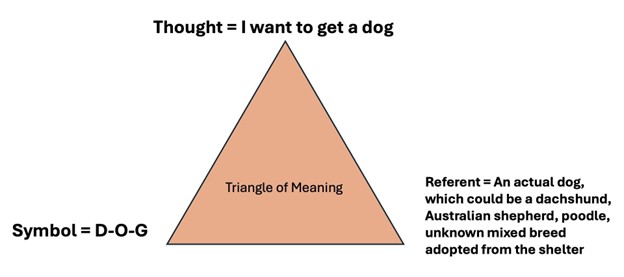
Source: Adapted from Richards & Ogden, 1923
Adapted by TRU from 3.1: Language and Meaning, Figure 3.1 which is shared under a CC BY-NC-SA 3.0 license and was authored, remixed, and/or curated by Anonymous via source content
Being aware of the indirect relationship between symbol and referent, we can try to compensate by getting clarification. Some of what we learned in the previous unit about perception checking can be useful here. Abby might ask Jasper, “What kind of dog do you have in mind?” This question would allow Jasper to describe his referent, which would allow for more shared understanding. If Jasper responds, “Well, I like short-haired dogs. And we need a dog that will work well in an apartment,” then there’s still quite a range of referents. Abby could ask questions for clarification, like “Sounds like you’re saying that a smaller dog might be better. Is that right?” Getting to a place of shared understanding can be difficult, even when we define our symbols and describe our referents.
Definitions
Definitions help us narrow the meaning of particular symbols, which also narrows a symbol’s possible referents. They also provide more words (symbols) for which we must determine a referent. If a concept is abstract and the words used to define it are also abstract, then a definition may be useless. Have you ever been caught in a verbal maze as you look up an unfamiliar word, only to find that the definition contains more unfamiliar words? Although this can be frustrating, definitions do serve a purpose.
Words Have Denotative and Connotative Meanings
Denotation refers to definitions that are accepted by the language group as a whole, or the dictionary definition of a word. For example, the denotation of the word cowboy is a male who takes care of cattle. Another denotation is a reckless and/or independent person. A more abstract word, like change, would be more difficult to understand due to the word having multiple denotations. Because both cowboy and change have multiple meanings, they are considered polysemic words. Monosemic words have only one use in a language, which makes their denotation more straightforward. Specialized academic or scientific words are often monosemic, but there are fewer commonly used monosemic words, for example, handkerchief. As you might guess based on our discussion of the complexity of language so far, there are far more polysemic words than monosemic words.
Connotation refers to definitions that are based on emotion or experience-based associations that people have with a word. To go back to our previous words, change can have positive or negative connotations depending on a person’s experiences. A person who just ended a long-term relationship may think of change as good or bad depending on what they thought about their former partner. Even monosemic words such as handkerchief that only have one denotation can have multiple connotations. A handkerchief can conjure up thoughts of dainty Southern belles or dirty rags used to blow your nose. A polysemic word like cowboy has many connotations, and philosophers of language have explored how connotations extend beyond one or two experiential or emotional meanings of a word to constitute cultural myths (Barthes, 1972). Cowboy, for example, connects to the frontier and western history of North America, which has mythologies associated with it that help shape the narrative of nations. The “Marlboro Man,” for example, is an enduring advertising icon that draws on connotations of the cowboy to attract customers. While people who grew up with cattle or have family who ranch may have a very specific connotation of the word cowboy based on personal experience, other people’s connotations may be more influenced by popular cultural symbolism such as that seen in westerns.
Activity 3: Personal Reflection Journal – Reflection Question 2
Please save your responses in a separate file so you can refer to them later in the course.
Reflection Question 2:
This activity contains text from 3.1: Language and Meaning which is shared under a CC BY-NC-SA 3.0 license and was authored, remixed, and/or curated by Anonymous via source content that was edited to the style and standards of the LibreTexts platform. Minor changes for readability and to add illustrations as cited from other sources.
Language Is Learned
The relationship between the symbols that make up our language and their referents is arbitrary, which means they have no meaning until we assign it to them. In order to effectively use a language system, we have to learn, over time, which symbols go with which referents, because we can’t just tell by looking at the symbol. You probably learned what the word apple meant by looking at the letters A-P-P-L-E and a picture of an apple and having a teacher or caregiver help you sound out the letters until you said the whole word. Over time, we associated that combination of letters with the picture of an apple and no longer had to sound each letter out. This is a deliberate process that may seem slow in the moment, but as we will see next, our ability to acquire language is actually quite astounding. We didn’t just learn individual words and their meanings, though; we also learned rules of grammar that help us put those words into meaningful sentences.

The Rules of Language
Any language system must have rules in order to make it learnable and usable. Grammar refers to the rules that govern how words are used to make phrases and sentences. Someone would likely know what you mean by the question, “Where’s the remote control?” But “The control remote where’s?” is likely to be unintelligible or at least confusing (Crystal, 2005, p. 8–9). Knowing the rules of grammar is important in order to be able to write and speak so that others understand us, but knowing these rules isn’t enough to make you an effective communicator. As we will learn later, creativity and play also have a role in effective verbal communication. Even though educators have long enforced the idea that there are right and wrong ways to write and say words, there really isn’t anything inherently right or wrong about the individual choices we make in our language use. Rather, it is our collective agreement that gives power to the rules that govern language.
Some linguists have viewed the rules of language as fairly rigid and limiting in terms of the possible meanings that we can derive from words and sentences created from within that system (de Saussure, 1974). Others have viewed these rules as more open and flexible, allowing a person to make choices to determine meaning (Eco, 1976). Still others have claimed that there is no real meaning and that possibilities for meaning are limitless (Derrida, 1978). For our purposes in this topic, we will take the middle perspective, which allows for the possibility of individual choice but still acknowledges that there is a system of rules and logic that guides our decision making.
Looking back to our discussion of connotation, we can see how individuals play a role in how meaning and language are related. We each bring our own emotional and experiential associations to a word that are often more meaningful than a dictionary definition. In addition, we have quite a bit of room for creativity, play, and resistance with the symbols we use. Have you ever had a secret code with a friend that only you knew? This can allow you to use a code word in a public place to get meaning across to the other person who is “in the know” without anyone else understanding the message. The fact that you can take a word, give it another meaning, have someone else agree on that meaning, and then use the word in your own way clearly shows that meaning is in people rather than words. As we will learn later, many slang words developed because people wanted a covert way to talk about certain topics like drugs or sex without outsiders catching on.
Language Acquisition
Language acquisition refers to the process by which we learn to understand, produce, and use words to communicate within a given language group. The way we acquire language is affected by many factors. We know that learning a language is not just about learning words. We have to learn how to connect the words correctly in a given context and be able to order the words so that other people will be able to understand us (Hayakawa & Hayakawa, 1990, p. 87). As if that didn’t seem like enough to learn, we also have to learn various conversational patterns that we regularly but often unconsciously follow to make our interactions smooth and successful. A brief overview of language acquisition from birth to adulthood offers us a look at the amazing and still somewhat mysterious relationships among our brain, eyes, ears, voice, and other physiological elements (Crystal, 2005, p. 8–9). In terms of language acquisition, there is a great deal of variation among individuals due to physical and contextual differences, but this overview describes what may be considered typical development.
During the first year of life, a great deal of information is taken in as brain development accelerates and senses are focused and tuned. Primary caregivers are driven, almost instinctively, to begin instilling conversational abilities in babies. As just about anyone who has spent time around a baby during this early phase of rapid development can attest, there is a compulsion to interact with the child, which is usually entertaining for both adult and baby. This compulsion isn’t random or accidental, and we would be wrong to assume that our communication is useless or just for fun. We would also be wrong to assume that language acquisition doesn’t begin until a baby says their first words. By the time this happens, babies have learned, through observation and practice, about our verbal communication and interaction patterns. These key developments include the following:
- 2–4 months. Babies can respond to different tones of voice (angry, soothing, or playful).
- 6 months. Babies can associate some words, like bye-bye, with a corresponding behaviour, and they begin “babbling,” which is actually practice for more intelligible speech to come.
- 8–10 months. Babies learn that pointing can attract or direct attention, and they begin to follow adult conversations, shifting eye contact from one speaker to the next.
- 1 year. Babies recognize some individual words (people’s names, no) and basic rituals of verbal interaction such as question-pause-answer and various greetings. Shortly before or after this time, babies begin to use “melodic utterances” echoing the variety in pitch and tone in various verbal interactions such as questioning, greeting, or wanting.

By the time children are one year old, they have learned many of the patterns of speech, even though they can’t yet put them into recognizable use.
Language acquisition after the age of two seems slow compared to the pace of development during the first year or so. By the end of the first year, babies have learned most of the basic phonetic components necessary for speech. The second year represents a time of intense practice of verbal trial and error. From three to five years of age, children continue to develop pronunciation ability, which develops enough by their teens to allow them to engage in everyday communication. Of course, human expressive repertoire, including ways of speaking and the vocabulary we use, continues to develop. A person’s life and career choices determine to a large degree how much further development occurs. But the language abilities we have acquired can decrease or disappear as a result of disease or trauma. Additionally, if such things occur early in life, or before birth, the process of language acquisition can be quite different. Barriers to speech and language acquisition are common and are the domain of a related but distinct field of study often housed in departments of communication sciences and disorders.
Key Takeaways
- The triangle of meaning is a model of communication that indicates the relationship among a thought, symbol, and referent, and highlights the indirect relationship between the symbol and the referent. The model explains how for any given symbol there can be many different referents, which can lead to misunderstanding.
- Denotation refers to the agreed on or dictionary definition of a word. Connotation refers to definitions that are based on emotion- or experience-based associations people have with a word.
- The rules of language help make it learnable and usable. Although the rules limit some of the uses of language, they still allow for the possibility of creativity and play.
- Language acquisition refers to the process by which we learn to understand, produce, and use words to communicate within a given language group. This process happens at an amazing speed during the first two years of life, and we attain all the linguistic information we need to participate in everyday conversations, assuming normal development, by our early teens.
Media Attributions
Corbin, D. (2017, April 20). Woman Carrying Baby While Walking [Photograph]. Unsplash. https://unsplash.com/photos/woman-carrying-baby-while-walking-PmNjS6b3XP4
Lauricella, S. (2025). Small dog. TRU.
White, B. (2016, October 11). Girl’s left hand wrap around toddler while reading book during golden hour [Photograph]. Unsplash. https://unsplash.com/photos/girls-left-hand-wrap-around-toddler-while-reading-book-during-golden-hour-EMZxDosijJ4
References
Anonymous. (n.d.). Section 3.1: Language and Meaning. In Introduction to communication. LibreTexts. https://socialsci.libretexts.org/Bookshelves/Communication/Introduction_to_Communication/Communication_in_the_Real_World_-_An_Introduction_to_Communication_Studies/03%3A_Verbal_Communication/3.01%3A_Language_and_Meaning
Barthes, R. (1972). Mythologies. Hill and Wang.
Crystal, D. (2005). How language works: How babies babble, words change meaning, and languages live or die. Overlook Press.
de Saussure, F. (1974). Course in general linguistics (W. Baskin, Trans.). Fontana/Collins.
Derrida, J. (1978). Writing and difference (A. Bass, Trans.). Routledge.
Eco, U. (1976). A theory of semiotics. Indiana University Press.
Hayakawa, S. I., & Hayakawa, A. R. (1990). Language in thought and action (5th ed.). Harcourt Brace.
Leeds-Hurwitz, W. (1993). Semiotics and communication: Signs, codes, cultures. Lawrence Erlbaum Associates.
Richards, I. A., & Ogden, C. K. (1923). The meaning of meaning. Kegan, Paul, Trench, Tubner.