Topic 2: Theories and Elements of Nonverbal Communication
Activity 5: Reading – Nonverbal Communication
Please read the following text which introduces you to the theories and elements of nonverbal communication.
This activity contains text from 4.2: Types of Nonverbal Communication which is shared under a CC BY-NC-SA 3.0 license and was authored, remixed, and/or curated by Anonymous via source content that was edited to the style and standards of the LibreTexts platform. Minor changes for readability, to add Canadian context, and to add illustrations as cited from other sources.
Learning Objectives
- Define kinesics.
- Define haptics.
- Define vocalics.
- Define proxemics.
- Define chronemics.
- Provide examples of types of nonverbal communication that fall under these categories.
- Discuss the ways in which personal presentation and environment provide nonverbal cues.
Just as verbal language is broken up into various categories, there are also different types of nonverbal communication. As we learn about each type of nonverbal signal, keep in mind that nonverbals often work in concert with each other, combining to repeat, modify, or contradict the verbal message being sent.
Kinesics
The word kinesics comes from the root word kinesis, which means “movement,” and refers to the study of hand, arm, body, and face movements. Specifically, this section will outline the use of gestures, head movements and posture, eye contact, and facial expressions as nonverbal communication.
Gestures
There are three main types of gestures: adaptors, emblems, and illustrators (Andersen, 1999, p. 36). Adaptors are touching behaviours and movements that indicate internal states typically related to arousal or anxiety. Adaptors can be targeted toward the self, objects, or others. In regular social situations, adaptors result from uneasiness, anxiety, or a general sense that we are not in control of our surroundings. Many of us subconsciously click pens, shake our legs, or engage in other adaptors during classes, meetings, or while waiting as a way to do something with our excess energy.
Public speaking students who watch video recordings of their speeches notice nonverbal adaptors that they didn’t know they used. In public speaking situations, people most commonly use self- or object-focused adaptors. Common self-touching behaviours like scratching, twirling hair, or fidgeting with fingers or hands are considered self-adaptors. Some self-adaptors manifest internally, as coughs or throat-clearing sounds. Some people favour object adaptors. For example, they may subconsciously gravitate toward metallic objects like paper clips or staples holding notes together and either bend or fidget with them while speaking. Other people play with dry-erase markers, their note cards, the change in their pockets, or the lectern. Use of object adaptors can also signal boredom as people play with the straw in their drink or peel the label off a bottle of beer. Smartphones have become common object adaptors, as people can fiddle with their phones to help ease anxiety.
Emblems are gestures that have a specific agreed-on meaning. These are still different from the signs used by hearing-impaired people or others who communicate using American Sign Language (ASL). Even though they have a generally agreed-upon meaning, they are not part of a formal sign system like ASL that is explicitly taught to a group of people. A hitchhiker’s raised thumb, the “OK” sign with thumb and index finger connected in a circle with the other three fingers sticking up, and the raised middle finger are all examples of emblems that have an agreed-on meaning or meanings with a culture. Emblems can be still or in motion; for example, circling the index finger around at the side of your head usually means, “That person is being ridiculous” or rolling your hands over and over in front of you says, “Move on.”

Emblems are gestures that have a specific meaning. In Canada, a thumbs-up can mean “I need a ride” or “OK!”.
Just as we can trace the history or etymology of a word, we can also trace some nonverbal signals, especially emblems, to their origins. Holding up the index and middle fingers in a “V” shape with the palm facing in is an insult gesture in Britain that basically means “up yours.” This gesture dates back centuries to the period in which the primary weapon of war was the bow and arrow. When archers were captured, their enemies would often cut off one or both fingers, which was seen as the ultimate insult and worse than being executed since the archer could no longer shoot their bow and arrow. So holding up the two fingers was a provoking gesture used by archers to show their enemies that they still had their shooting fingers (Pease & Pease, 2004, p. 121).
Illustrators are the most common type of gesture and are used to add visual to the verbal message they accompany. For example, you might use hand gestures to indicate the size or shape of an object. Unlike emblems, illustrators do not typically have meaning on their own and are used more subconsciously than emblems. These largely involuntary and seemingly natural gestures flow from us as we speak, but vary in terms of intensity and frequency based on context. Although we are never explicitly taught how to use illustrative gestures, we do it automatically. For example, you might see someone talking on their cellphone and they still gesture when having an animated conversation on the phone even though the other person can’t see them.
Head Movements and Posture
Head movements and posture are grouped together because they are often used to both acknowledge others and communicate interest or attentiveness. In terms of head movements, a head nod is a universal sign of acknowledgement in cultures where the formal bow is not (or is no longer) used as a greeting. In these cases, the head nod essentially serves as an abbreviated bow. An innate and universal head movement is the headshake back and forth to signal “no.” This nonverbal signal begins at birth, even before a baby has the ability to know that it has a corresponding meaning. Babies shake their head from side to side to reject their mother’s breast and later shake their head to reject attempts to spoon-feed (Pease & Pease, 2004, p. 121). This biologically based movement then stays with us to be a recognizable signal for “no.” We also move our head to indicate interest. For example, a head up typically indicates an engaged or neutral attitude, a head tilt indicates interest and is an innate submission gesture that exposes the neck and subconsciously makes people feel more trusting of us, and a head down signals a negative or aggressive attitude (Pease & Pease, 2004, p. 121).
There are four general human postures: standing, sitting, squatting, and lying down (Hargie, 2011, p. 63). Within each of these postures there are many variations, and when combined with particular gestures or other nonverbal cues they can express many different meanings. Most of our communication occurs while we are standing or sitting. One interesting standing posture involves putting our hands on our hips and is a nonverbal cue that we use subconsciously to make us look bigger and show assertiveness. When the elbows are pointed out, this prevents others from getting past us as easily and is a sign of attempted dominance or a gesture that says we’re ready for action. In terms of sitting, leaning back shows informality and indifference, straddling a chair is a sign of dominance (but also some insecurity because the person is protecting the vulnerable front part of their body), and leaning forward shows interest and attentiveness (Pease & Pease, 2004. p. 121).
Eye Contact
We also communicate through eye behaviours, primarily eye contact. While eye behaviours are often studied under the category of kinesics, they have their own branch of nonverbal studies called oculesics, which comes from the Latin word oculus, meaning “eye.” The face and eyes are the main point of focus during communication, and along with our ears our eyes take in most of the communicative information around us. The saying “The eyes are the window to the soul” can be accurate in terms of where people typically think others are “located,” which is right behind the eyes (Andersen, 1999, p. 36). Certain eye behaviours have become tied to personality traits or emotional states, as illustrated in phrases such as “hungry eyes,” “evil eyes,” and “bedroom eyes.” To better understand oculesics, we will discuss the characteristics and functions of eye contact and pupil dilation.
Eye contact serves several communicative functions including regulating interaction, monitoring interaction, conveying information, and establishing interpersonal connections. In terms of regulating communication, we use eye contact to signal to others that we are ready to speak or we use it to cue others to speak. I’m sure we’ve all been in that awkward situation when a teacher asks a question, no one else offers a response, and they look directly at us as if to say, “What do you think?” In that case, the teacher’s eye contact is used to cue us to respond. During an interaction, eye contact also changes as we shift from speaker to listener. North Americans typically shift eye contact while speaking—looking away from the listener and then looking back at their every few seconds. Toward the end of our speaking turn, we make more direct eye contact with our listener to indicate that we are finishing up. While listening, we tend to make more sustained eye contact, not glancing away as regularly as we do while speaking (Martin & Nakayama, 2010, p. 276).
Aside from regulating conversations, eye contact is also used to monitor interaction by taking in feedback and sending information. Our eyes bring in the visual information we need to interpret people’s movements, gestures, and eye contact. A speaker can use their eye contact to determine if an audience is engaged, confused, or bored and then adapt their message accordingly. Our eyes also send information to others. People know not to interrupt when we are in deep thought because we naturally look away from others when we are processing information. Making eye contact with others also communicates that we are paying attention and are interested in what another person is saying. As we will learn in the unit on Listening, eye contact is a key part of active listening.
Eye contact can also be used to intimidate others. We have social norms about how much eye contact we make with people, and those norms vary depending on both the setting and the person. Staring at another person in some contexts could communicate intimidation, while in other contexts it could communicate flirtation. As we learned, eye contact is a key immediacy behaviour, and it signals to others that we are available for communication. Once communication begins, if it does, eye contact helps establish rapport or connection. We can also use our eye contact to signal that we do not want to make a connection with others. For example, in a public setting such as an airport or a gym where people often make small talk, we can avoid making eye contact with others to indicate that we do not want to engage in small talk with strangers. Another person could use eye contact to try to coax you into speaking, though. For example, when one person continues to stare at another person who is not reciprocating eye contact, the person avoiding eye contact might eventually give in, become curious, or become irritated and say, “Can I help you with something?” As you can see, eye contact sends and receives important communicative messages that help us interpret others’ behaviours, convey information about our thoughts and feelings, and facilitate or impede rapport or connection. This list reviews the specific functions of eye contact:
- Regulate interaction and provide turn-taking signals
- Monitor communication by receiving nonverbal communication from others
- Signal cognitive activity (we look away when processing information)
- Express engagement (we show people we are listening with our eyes)
- Convey intimidation
- Express flirtation
- Establish rapport or connection
Pupil dilation is a subtle component of oculesics that has not received as much scholarly attention in communication as has eye contact. Pupil dilation refers to the expansion and contraction of the black part of the center of our eyes and is considered a biometric form of measurement; it is involuntary and therefore seen as a valid and reliable form of data collection as opposed to self-reports on surveys or interviews that can be biased or misleading. Our pupils dilate when there is a lack of lighting and contract when light is plentiful (Guerrero & Floyd, 2006, p. 176). Pain, sexual attraction, general arousal, anxiety/stress, and information processing (thinking) also affect pupil dilation. Researchers measure pupil dilation for a number of reasons. For example, advertisers use pupil dilation as an indicator of consumer preferences, assuming that more dilation indicates arousal and attraction to a product. We don’t consciously read others’ pupil dilation in our everyday interactions, but experimental research has shown that we subconsciously perceive pupil dilation, which affects our impressions and communication. In general, dilated pupils increase a person’s attractiveness. Even though we may not be aware of this subtle nonverbal signal, we have social norms and practices that may be subconsciously based on pupil dilation. Take for example the notion of mood lighting and the common practice of creating a “romantic” ambiance with candlelight or the light from a fireplace. Softer and more indirect light leads to pupil dilation, and although we intentionally manipulate lighting to create a romantic ambiance, not to dilate our pupils, the dilated pupils are still subconsciously perceived, which increases perceptions of attraction (Andersen, 1999, p. 36).
Facial Expressions
Our faces are the most expressive part of our bodies. Think of how photos are often intended to capture a particular expression “in a flash” to preserve for later viewing. Even though a photo is a snapshot in time, we can still interpret much meaning from a human face caught in a moment of expression, and basic facial expressions are recognizable by humans all over the world. Much research has supported the universality of a core group of facial expressions: happiness, sadness, fear, anger, and disgust. The first four are especially identifiable across cultures (Andersen, 1999, p. 36). However, the triggers for these expressions and the cultural and social norms that influence their displays are still culturally diverse. If you’ve spent time with babies you know that they are capable of expressing all these emotions. Getting to see the pure and innate expressions of joy and surprise on a baby’s face is what makes playing peek-a-boo so entertaining for adults. As we get older, we learn and begin to follow display rules for facial expressions and other signals of emotion. We also learn to better control our emotional expression based on the norms of our culture.
Smiles are powerful communicative signals and, as you’ll recall, are a key immediacy behaviour. Although facial expressions are typically viewed as innate and several are universally recognizable, they are not always connected to an emotional or internal biological stimulus; they can actually serve a more social purpose. For example, most of the smiles we produce are primarily made for others and are not just an involuntary reflection of an internal emotional state (Andersen, 1999, p. 36). These social smiles, however, are slightly but perceptibly different from more genuine smiles. People generally perceive smiles as more genuine when the other person smiles “with their eyes.” This particular type of smile is difficult if not impossible to fake because the muscles around the eye that are activated when we spontaneously or genuinely smile are not under our voluntary control. It is the involuntary and spontaneous contraction of these muscles that moves the skin around our cheeks, eyes, and nose to create a smile that’s distinct from a fake or polite smile (Evans, 2001, p. 107). People are able to distinguish the difference between these smiles, which is why photographers often joke with adults or use props with children to induce a genuine smile before they snap a picture.

Our faces are the most expressive part of our body and can communicate an array of different emotions.
Facial expressions help set the emotional tone for a speech. In order to set a positive tone before you start speaking in a public or academic context, briefly look at the audience and smile to communicate friendliness, openness, and confidence. Beyond your opening and welcoming facial expressions, you can communicate a range of emotions that your audience can use to infer personality traits and make judgments about your credibility and competence. Facial expressions can communicate that a speaker is tired, excited, angry, confused, frustrated, sad, confident, smug, shy, or bored. Even if you aren’t bored, for example, a slack face with little animation may lead an audience to think that you are bored with your own speech, which isn’t likely to motivate them to be interested. So make sure your facial expressions are communicating an emotion, mood, or personality trait that you think your audience will view favourably, and that will help you achieve your speech goals. Also make sure that your facial expressions match the content of your speech. When delivering something light-hearted or humorous, a smile, bright eyes, and slightly raised eyebrows will nonverbally enhance your verbal message. When delivering something serious or somber, a furrowed brow, a tighter mouth, and even a slight head nod can enhance that message. If your facial expressions and speech content are not consistent, your audience could become confused by the mixed messages, which could lead them to question your honesty and credibility.
Activity 6: Interactive – Image Pairing Activity
Please complete the following interactive activity, then finish the topic reading.
This activity contains text from 4.2: Types of Nonverbal Communication which is shared under a CC BY-NC-SA 3.0 license and was authored, remixed, and/or curated by Anonymous via source content that was edited to the style and standards of the LibreTexts platform. Minor changes for readability and to add illustrations as cited from other sources.
Haptics
Think of how touch has the power to comfort someone in a moment of sorrow when words alone cannot. This positive power of touch is countered by the potential for touch to be threatening because of its connection to sex and violence. To learn about the power of touch, we turn to the study of haptics, which refers to communication by touch. We probably get more explicit advice and instruction on how to use touch than any other form of nonverbal communication. A lack of nonverbal communication competence related to touch could have negative interpersonal consequences. For example, if someone doesn’t follow advice about the importance of a firm handshake and instead uses a weak grip, people they meet might make negative judgments about their confidence or credibility. A lack of competence could have more dire consequences, including legal punishment, if someone touches another person inappropriately (intentionally or unintentionally). Touch is necessary for human social development: it can be welcoming, threatening, or persuasive. Research has shown that students evaluated a library and its staff more favourably if the librarian briefly touched the patron while returning their library card, that female restaurant servers received larger tips when they touched patrons, and that people were more likely to sign a petition when the petitioner touched them during their interaction (Andersen, 1999. p. 36).
There are several types of touch, including functional-professional, social-polite, friendship-warmth, love-intimacy, and sexual-arousal touch (Heslin & Apler, 1983, p. 47–76). At the functional-professional level, touch is related to a goal or part of a routine professional interaction, which makes it less threatening and more expected. For example, we let barbers, hairstylists, doctors, nurses, tattoo artists, and security screeners touch us in ways that would otherwise be seen as intimate or inappropriate if not in a professional context. At the social-polite level, socially sanctioned touching behaviours help initiate interactions and show that others are included and respected. A handshake, a pat on the arm, and a pat on the shoulder are examples of social-polite touching. A handshake is actually an abbreviated hand-holding gesture, but we know that prolonged hand-holding would be considered too intimate and therefore inappropriate at the functional-professional or social-polite level. At the functional-professional and social-polite levels, touch still has interpersonal implications. The touch, although professional and not intimate, between hair stylist and client, or between medical professional and patient, has the potential to be therapeutic and comforting. In addition, a social-polite touch exchange plays into initial impression formation, which can have important implications for how an interaction and a relationship unfold.
Of course, touch is also important at more intimate levels. At the friendship-warmth level, touch is more important and more ambiguous than at the social-polite level. At this level, touch interactions are important because they serve a relational maintenance purpose and communicate closeness, liking, care, and concern. The types of touching at this level also vary greatly from more formal and ritualized to more intimate, which means friends must sometimes negotiate their own comfort level with various types of touch and may encounter some ambiguity if their preferences don’t match up with their relational partner’s. In a friendship, for example, too much touch can signal sexual or romantic interest, and too little touch can signal distance or unfriendliness. At the love-intimacy level, touch is more personal and is typically only exchanged between significant others, such as best friends, close family members, and romantic partners. Touching faces, holding hands, and full frontal embraces are examples of touch at this level. Although this level of touch is not sexual, it does enhance feelings of closeness and intimacy and can lead to sexual-arousal touch, which is the most intimate form of touch, as it is intended to physically stimulate another person.
Touch is also used in many other contexts—for example, during play (e.g., arm wrestling), during physical conflict (e.g., shoving), and during conversations (e.g., to get someone’s attention) (Jones, 1999). We also inadvertently send messages through accidental touch (e.g., bumping into someone). It can be very interesting to go to a restaurant and observe “first-date behavior,” and even try to predict whether or not there is going to be a second date based on a couple’s nonverbal communication. Now that many couples meet online before meeting face-to-face, first meetings are particularly illustrative. What sort of touching behaviours do you think would indicate a good or bad first date?

Facial expression and touch can communicate an array of different emotions.
During a first date or less formal initial interactions, quick fleeting touches give an indication of interest. For example, a pat on the back is an abbreviated hug (Andersen, 1999, p. 36). In general, the presence or absence of touching cues us into people’s emotions. So as people on a date sit across from each other, one person may lightly tap the other’s arm after the other said something funny. If the couple is sitting side by side, one person may cross their legs and lean toward the other person so that each person’s knees or feet occasionally touch. Touching behaviour as a way to express feelings is often reciprocal. A light touch from one person could be followed by a light touch from the other to indicate that the first touch was okay. While verbal communication could also be used to indicate romantic interest, many people feel too vulnerable at this early stage in a relationship to articulate their feelings aloud. If your date advances a touch and you are not interested, it is also unlikely that you will come right out and say, “Sorry, but I’m not really interested in you.” Instead, due to common politeness rituals, you would be more likely to respond with other forms of nonverbal communication such as withdrawing, sitting further away from the other person, crossing your arms, or simply not acknowledging the touch.
Hugging behaviour is particularly interesting in western culture. A hug can be obligatory, meaning that you do it because you feel like you have to, not because you want to. Even though you may think that this type of hug doesn’t communicate emotions, it certainly does. A limp, weak, or retreating hug may communicate anger, ambivalence, or annoyance. Think of other types of hugs and how you hug different people. Some types of hugs are the crisscross hug, the neck-waist hug, and the engulfing hug (Floyd, 2006, p. 33–34). The crisscross hug is a rather typical hug where each person’s arm is below or above the other person’s arm. This hug is common among friends, romantic partners, and family members, and perhaps even coworkers. The neck-waist hug usually occurs in more intimate relationships as it involves one person’s arms around the other’s neck and the other person’s arms around the other’s waist. This type of hug could be considered the “slow-dance hug.” The engulfing hug is similar to a bear hug in that one person completely wraps the arms around the other as that person basically stands there. This hugging behaviour usually occurs when someone is very excited and hugs the other person without warning.
Some other types of hugs are the “shake-first-then-tap hug” and the “back-slap hug.” These hugs are most often between men. The shake-first-then-tap hug involves a modified hand-shake where the hands are joined more with the thumb and fingers than the palm and the elbows are bent so that the shake occurs between the two huggers’ chests. The hug then comes after the shake has been initiated with one arm going around the other person for usually just one tap, then a step back and release of the handshake. In this hugging behaviour, the handshake that is maintained between the chests minimizes physical closeness and the intimacy that may be interpreted from the crisscross or engulfing hug where the majority of the huggers’ torsos are touching. This move away from physical closeness likely stems from a cultural norm that restricts men’s physical expression of affection due to homophobia. The slap hug is also a less physically intimate hug and involves a hug with one or both people slapping the other person’s back repeatedly, often while talking to each other. This type of hug could go on for many seconds and with varying degrees of force involved in the slap. When the slap is more of a tap, it is actually an indication that one person wants to let go.
Activity 7: Reading – Space and Territoriality
This activity contains text from 4.2: Types of Nonverbal Communication which is shared under a CC BY-NC-SA 3.0 license and was authored, remixed, and/or curated by Anonymous via source content that was edited to the style and standards of the LibreTexts platform. Minor changes for readability, to add Canadian context, and to add illustrations as cited from other sources.
Vocalics
We learned earlier that paralanguage refers to the vocalized but nonverbal parts of a message. Vocalics is the study of paralanguage, which includes the vocal qualities that go along with verbal messages, such as pitch, volume, rate, vocal quality, and verbal fillers (Andersen, 1999, p. 36).
Pitch helps convey meaning, regulate conversational flow, and communicate the intensity of a message. Even babies recognize a sentence with a higher pitched ending as a question. We also learn that greetings have a rising emphasis and farewells have falling emphasis. Of course, no one ever tells us these things explicitly; we learn them through observation and practice. We do not pick up on some more subtle and/or complex patterns of paralanguage involving pitch until we are older. Children, for example, have a difficult time perceiving sarcasm, which is usually conveyed through paralinguistic characteristics such as pitch and tone rather than the actual words being spoken. Some people have difficulty reading sarcasm in another person’s voice and instead may interpret what they say literally (Andersen, 1999, p. 36).
Paralanguage provides important context for the verbal content of speech. For example, volume helps communicate intensity. A louder voice is usually thought of as more intense, although a soft voice combined with a certain tone and facial expression can be just as intense. We typically adjust our volume based on our setting, the distance between people, and the relationship. In our age of computer-mediated communication, TYPING IN ALL CAPS is usually seen as offensive, as it is equated with yelling. A voice at a low volume or a whisper can be very appropriate when sending a covert message or flirting with a romantic partner, but it wouldn’t enhance a person’s credibility if used during a professional presentation.
Speaking rate refers to how fast or slow a person speaks and can lead others to form impressions about our emotional state, credibility, and intelligence. As with volume, variations in speaking rate can interfere with the ability of others to receive and understand verbal messages. A slow speaker could bore others and lead their attention to wander. A fast speaker may be difficult to follow, and the fast delivery can actually distract from the message. Speaking a little faster than the normal 120–150 words a minute, however, can be beneficial, as people tend to find speakers whose rate is above average more credible and intelligent (Buller & Burgoon, 1986). When speaking at a faster-than-normal rate, it is important that a speaker also clearly articulate and pronounce their words. Boomhauer, a character on the show King of the Hill, is an example of a speaker whose fast rate of speech combines with a lack of articulation and pronunciation to create a stream of words that only he can understand. Rory and Lorelei Gilmore of Gilmore Girls are known to have had rapid exchanges and a fast speech pattern, but their conversations are understandable by audiences.
Our tone of voice can be controlled somewhat with pitch, volume, and emphasis, but each voice has a distinct quality known as a vocal signature. Voices vary in terms of resonance, pitch, and tone, and some voices are more pleasing than others. People typically find pleasing voices that employ vocal variety and are not monotone, are lower pitched (particularly for males), and do not exhibit particular regional accents. Many people perceive nasal voices negatively and assign negative personality characteristics to them (Andersen, 1999, p. 36). Think about people who have very distinct voices. Whether they are an actor like Morgan Freeman, a singer like Lady Gaga, or fictional characters like Minnie and Mickey Mouse, some voices stick with us and make a favorable or unfavorable impression.
Verbal fillers are sounds that fill gaps in our speech as we think about what to say next. They are considered a part of nonverbal communication because they are not like typical words that stand in for a specific meaning or meanings. Verbal fillers such as “um,” “uh,” “like,” and “ah” are common in regular conversation and are not typically disruptive. As we learned earlier, the use of verbal fillers can help a person “keep the floor” during a conversation if they need to pause for a moment to think before continuing on with verbal communication. Verbal fillers in more formal settings, such as a public speech, can impact a speaker’s credibility.
The following is an outline of various communicative functions of vocalics:
- Repetition. Vocalic cues reinforce other verbal and nonverbal cues (e.g., saying “I’m not sure” with an uncertain tone, as if it were a question).
- Complementing. Vocalic cues elaborate on or modify verbal and nonverbal meaning (e.g., the pitch and volume used to say “I love sweet potatoes” would add context to the meaning of the sentence, such as the degree to which the person loves sweet potatoes or the use of sarcasm). The difference between “I LOVE sweet potatoes!” and “Oh I just looove sweet potatoes…” indicates how someone feels about a specific food.
- Accenting. Vocalic cues allow us to emphasize particular parts of a message, which helps determine meaning (e.g., “She is my friend,” or “She is my friend,” or “She is my friend”).
- Substituting. Vocalic cues can take the place of other verbal or nonverbal cues (e.g., saying “uh huh” instead of “I am listening and understand what you’re saying”).
- Regulating. Vocalic cues help regulate the flow of conversations (e.g., falling pitch and slowing rate of speaking usually indicate the end of a speaking turn).
- Contradicting. Vocalic cues may contradict other verbal or nonverbal signals (e.g., a person could say “I’m fine” in a quick, short tone that indicates otherwise).
Proxemics
Proxemics refers to the study of how space and distance influence communication. We can look at the ways in which space shows up in common metaphors to see that space, communication, and relationships are closely related. For example, when we are content with and attracted to someone, we say we are “close” to them. When we lose connection with someone, we may say they are “distant.” In general, space influences how people communicate and behave. Smaller spaces with a higher density of people often lead to breaches of our personal space bubbles. If this is a setting in which this type of density is expected beforehand, such as at a crowded concert or on a train during rush hour, then we make various communicative adjustments to manage the space issue. Unexpected breaches of personal space can lead to negative reactions, especially if we feel someone has violated our space voluntarily, meaning that a crowding situation didn’t force them into our space. To better understand how proxemics functions in nonverbal communication, we will more closely examine the proxemic distances associated with personal space and the concept of territoriality.
Proxemic Distances
We all have varying definitions of what our “personal space” is, and these definitions are contextual and depend on specific situations or relationships. Although our personal space “bubbles” are invisible, people are socialized into the norms of personal space within their cultural group. Scholars have identified four general zones including public, social, personal, and intimate distance (Hall, 1968). While this research was on participants in the US, the same could be argued for other English-speaking nations, but the zones may be different in specific places depending on the proportion of immigrants or specific cultural areas. The zones are more elliptical than circular, taking up more space in our front, where our line of sight is, than at our side or back where we can’t monitor what people are doing. You can see how these zones relate to each other and to the individual in Figure 4.2.1.
Even within a particular zone, interactions may differ depending on whether someone is in the outer or inner part of the zone.
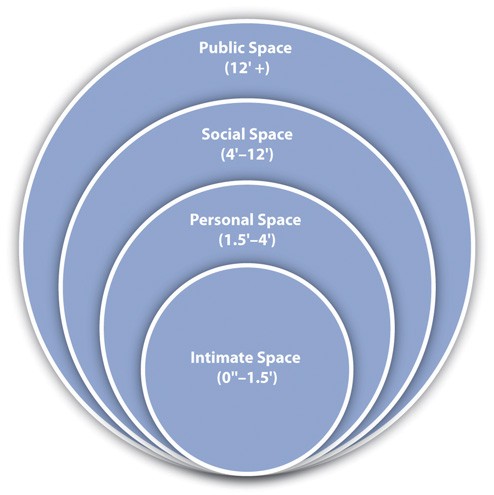
Public and Social Space
Public and social zones refer to the space 4 or more feet away from our body. The communication that typically occurs in these zones is formal and not intimate.
Public Space (12 Feet or More)
Public space starts about 12 feet from a person and extends out from there. This is the least personal of the four zones and would typically be used when a person is engaging in a formal speech and is removed from an audience to allow those in attendance to see. An example of public space is also observed when a high-profile or powerful person such as a celebrity or executive maintains such a distance as a sign of power or for safety and security reasons. In terms of regular interaction, we are often not obligated or expected to acknowledge or interact with people who enter our public zone. It would be difficult to have a deep conversation with someone at this level because you have to speak louder and don’t have the physical closeness that is often needed to promote emotional closeness and/or establish rapport.
Social Space (4–12 Feet)
Communication that occurs in the social zone, which is 4 to 12 feet away from our body, is typically in the context of a professional or casual interaction, but not intimate or public. This distance is preferred in many professional settings because it reduces the suspicion of any impropriety. The expression “keep someone at an arm’s length” means that someone is kept out of one’s personal space and kept in the social/professional space. If two people held up their arms and stood so just the tips of their fingers were touching, they would be around 4 feet away from each other, which is perceived as a safe distance because the possibility for intentional or unintentional touching does not exist.
It is also possible to have people in the outer portion of our social zone but not feel obligated to interact with them, but when people come closer than 6 feet to us, then we often feel obligated to at least acknowledge their presence. In many classrooms, much of the audience for a speech will actually be in your social zone rather than your public zone, which is beneficial because it helps you establish a better connection with them. Students in large lecture classes should consider sitting within the social zone of the professor because students who sit within this zone are more likely to be remembered by the professor, be acknowledged in class, and retain more information. The benefits of remaining in one’s social zone happen because people — in this case, students — are close enough to take in important nonverbal and visual cues. Students who talk to an instructor after class typically stand about 4 to 5 feet away when they speak, which keeps them in the outer part of the social zone, which is typical for professional interactions. When students have more personal information to discuss, they will come closer, which brings them into the inner part of the social zone.
Personal Space (1.5–4 Feet)
Personal and intimate zones refer to the space that starts at our physical body and extends four feet. These zones are reserved for friends, close acquaintances, and significant others. Much of our communication occurs in the personal zone, which is what we typically think of as our “personal space bubble” and extends from 1.5 feet to 4 feet away from our body. Even though we are getting closer to the physical body of another person, we may use verbal communication at this point to signal that our presence in this zone is friendly and not intimate. Even people who know each other could be uncomfortable spending too much time in this zone unnecessarily. This zone is broken up into two subzones, which helps us negotiate close interactions with people with whom we may not be close interpersonally (McKay et al., 1995, p. 59). The outer-personal zone extends from 2.5 feet to 4 feet and is useful for conversations that need to be private but that occur between people who are not interpersonally close. This zone allows for relatively intimate communication but doesn’t convey the intimacy that a closer distance would. The inner-personal zone extends from 1.5 feet to 2.5 feet and is a space reserved for communication with people with whom we are interpersonally close or trying to get to know. In this subzone, we can easily touch the other person as we talk to them, briefly placing a hand on their arm or engaging in other light social touching that facilitates conversation, self-disclosure, and feelings of closeness.
Intimate Space
As we approach the invisible line that is 1.5 feet from our body, we enter the intimate zone, which is reserved for only the closest friends, family, and romantic/intimate partners. It is impossible to completely ignore people when they are in this space, even if we are trying to pretend that we’re ignoring them. A breach of this space can be comforting in some contexts and annoying or frightening in others. We need regular human contact that isn’t just verbal but also physical. We have already discussed the importance of touch in nonverbal communication, and in order for that much-needed touch to occur, people have to enter our intimate space. Being close to someone and feeling their physical presence can be very comforting when words fail. There are also social norms regarding the amount of this type of closeness that can be expressed in public, as some people get uncomfortable even seeing others interacting in the intimate zone. While some people are comfortable engaging in or watching others engage in PDAs (public displays of affection), others are not.
So what happens when our space is violated? Although these zones are well established in research for personal space preferences, individuals vary in terms of their reactions to people entering certain zones, and determining what constitutes a “violation” of space is subjective and contextual. For example, another person’s presence in our social or public zones doesn’t typically arouse suspicion or negative physical or communicative reactions, but it could in some situations or with certain people. However, many situations lead to our personal and intimate space being breached by others against our will, and these breaches are more likely to be upsetting, even when they are expected. We’ve all had to get into a crowded elevator or wait in a long line. In such situations, we may rely on some verbal communication to reduce immediacy and indicate that we are not interested in closeness and are aware that a breach has occurred. People make comments about the crowd, saying, “We’re really packed in here like sardines,” or use humour to indicate that they are pleasant and well adjusted yet uncomfortable with the breach just as many people would be. Interestingly, as we will learn in our discussion of territoriality below, we do not often use verbal communication to defend our personal space during regular interactions. Instead, we rely on more nonverbal communication such as moving, crossing our arms, or avoiding eye contact to deal with breaches of space.
Territoriality
Territoriality is an innate drive to take up and defend spaces. This drive is shared by many creatures and entities, ranging from packs of animals to individual humans to nations. Whether it’s a neighbourhood claimed by a particular salesperson, your preferred place to sit in a restaurant, your usual desk in the classroom, or the seat you’ve saved while getting concessions at a sporting event, we claim certain spaces as our own. There are three main divisions for territory: primary, secondary, and public (Hargie, 2011, p. 63). Sometimes our claim to a space is official. These spaces are known as our primary territories because they are marked or understood to be exclusively ours and under our control. A person’s house, yard, room, desk, side of the bed, or shelf in the medicine cabinet could be considered primary territories.
Secondary territories don’t belong to us and aren’t exclusively under our control, but they are associated with us. This association may lead us to assume that the space will be open and available to us when we need it without us taking any further steps to reserve it. This happens regularly in classrooms. Students often sit in the same desk or at least same general area as they did on the first day of class. There may be some small adjustments during the first couple of weeks, but by a month into the semester, most students do not move around voluntarily. When someone else takes a student’s regular desk, the student whose usual spot is taken often gets surprised or annoyed.
Public territories are open to all people. People are allowed to mark public territory and use it for a limited period of time, but space is often up for grabs, which makes public space difficult to manage for some people and can lead to conflict. To avoid this type of situation, people use a variety of objects that are typically recognized by others as nonverbal cues that mark a place as temporarily reserved—for example, leaving a jacket, backpack, papers, or a drink. There is some ambiguity in the use of markers, however. A half-empty cup of coffee may be seen as trash and thrown away, which would be an annoying surprise to a person who left it to mark their table while visiting the restroom. One scholar’s informal observations revealed that a full drink sitting on a table could reserve a space in a university cafeteria for more than an hour, but a cup only half full usually only worked as a marker of territory for less than ten minutes. People have to decide how much value they want their marker to have. Obviously, leaving a laptop on a table indicates that the table is occupied, but it could also lead to the laptop getting stolen. A pencil, on the other hand, could just be moved out of the way and the space taken over.
Chronemics
Chronemics refers to the study of how time affects communication. Time can be classified into several different categories, including biological, personal, physical, and cultural time (Andersen, 1999, p. 36). Biological time refers to the rhythms of living things. Humans follow a circadian rhythm, meaning that we are on a daily cycle that influences when we eat, sleep, and wake. When our natural rhythms are disturbed by all-nighters, jet lag, or other scheduling abnormalities, our physical and mental health, communication competence, and personal relationships can suffer. It is helpful to keep biological time in mind as you communicate with others. Early morning conversations, presentations, or speeches may require more preparation to get yourself awake enough to communicate well and a more patient or energetic delivery to accommodate others who may still be getting warmed up for their day.
Personal time refers to the ways in which individuals experience time. The way we experience time varies based on our mood, interest level, and other factors. Think about how quickly time passes when you are interested in and therefore engaged in something. Perhaps you’ve been in fifty-minute classes that seemed to drag on forever and three-hour classes that zipped by. Individuals also vary based on whether or not they are future or past oriented. People with past-time orientations may want to reminisce about the past, reunite with old friends, and put considerable time into preserving memories and keepsakes in scrapbooks and photo albums. People with future-time orientations may spend the same amount of time making career and personal plans, writing out to-do lists, or researching future vacations, potential retirement spots, or what book they’re going to read next.
Physical time refers to the fixed cycles of days, years, and seasons. Physical time, especially seasons, can affect our mood and psychological states. Some people experience seasonal affective disorder that leads them to experience emotional distress and anxiety during the changes of seasons, primarily from warm and bright to dark and cold (summer to fall and winter).
Additionally, the way we use time depends in some ways on our status. For example, doctors often make their patients wait for extended periods of time, and executives and celebrities may run consistently behind schedule, thus making others wait for them. Promptness and the amount of time that is socially acceptable for tardiness and waiting varies among individuals and contexts.
Chronemics also considers the amount of time we spend talking. We have already learned that conversational turns and turn-taking patterns are influenced by social norms and can help our conversations to progress. We all know how annoying it can be when a person dominates a conversation or when we can’t get a person to contribute anything. The amount of time that someone spends talking — whether too long or too short — can affect our feelings about a message’s accuracy or value.
Personal Presentation and Environment
Personal presentation involves two components: our physical characteristics and the artifacts with which we adorn and surround ourselves. Physical characteristics include body shape, height, weight, attractiveness, and other physical features of our bodies. We do not have as much control over how these nonverbal cues are encoded as we do with many other aspects of nonverbal communication. As our unit on Perception noted, nonverbal characteristics play a large role in initial impression formation even though we know we “shouldn’t judge a book by its cover.” Although ideals of attractiveness vary among cultures and individuals, research consistently indicates that people who are deemed attractive based on physical characteristics have distinct advantages in many aspects of life. Further, media images often project unrealistic ideals of beauty, and have contributed to booming the health and beauty, dieting, gym, and plastic surgery industries. While there have been some controversial reality shows that seek to transform people’s physical characteristics, such as Extreme Makeover, Botched, and Nip/Tuck, the relative ease with which we can change the artifacts that send nonverbal cues about us has led to many more style and space makeover shows.
Have you ever tried to consciously change your “look?” Fashion magazines, TikTok videos, and Instagram accounts can tell people what they ought to be wearing, how they should style their hair, or what they can do to achieve a certain look, such as “Parisian” or “boho.” Sometimes, people embrace the “dress for the job you want” philosophy so they wear business casual attire to class or work. In all such cases, how one looks can affect how others perceive them.
Television programs like Queer Eye seek to show the power of wardrobe and personal style changes in how people communicate with others. Aside from clothes, items such as jewelry, visible body art, hairstyles, and other political, social, and cultural symbols send messages to others about who we are. They can also influence someone’s confidence and level of self-esteem. For example, Jonathan Van Ness works on transforming people’s hair so that how they look can influence how they feel and also influence how others perceive and even treat them. Jewelry can also send messages with varying degrees of direct meaning. A ring on the “ring finger” of a person’s left hand typically indicates that they are married or in an otherwise committed relationship. A thumb ring or a right-hand ring on the “ring finger” doesn’t send such a direct message.
People also adorn their clothes, body, or belongings with religious or cultural symbols, like a cross to indicate a person’s Christian faith or a rainbow flag to indicate that a person is a member of the LGBTQ2S+ community or an ally to one or more of those groups. People now wear various types of rubber bracelets, which have become a popular form of social cause marketing, to indicate that they identify with the “Livestrong” movement or support causes such as breast cancer awareness and research.
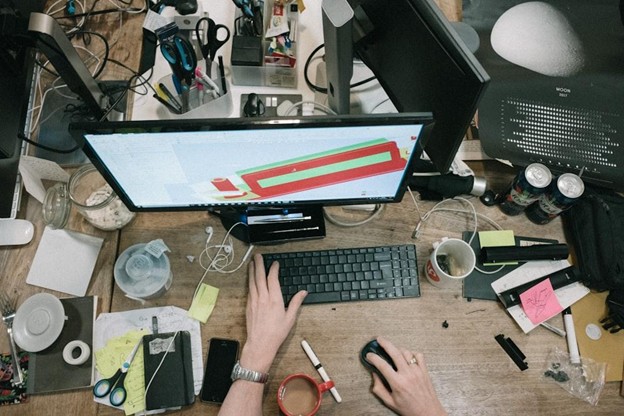
The objects that surround us send nonverbal cues that may influence how people perceive us. What impression does a messy, crowded office make?
The environment in which we interact can also affect our verbal and nonverbal communication. Environment is included in this discussion because we can often manipulate the nonverbal environment similar to how we would manipulate our gestures or tone of voice to suit our communicative needs. The books that we display on our coffee table, the magazines a doctor keeps in their waiting room, the placement of fresh flowers in a foyer, or a piece of chocolate on a hotel bed pillow all send particular messages. The placement of objects and furniture in a physical space can help create a formal, distant, friendly, or intimate climate. In terms of formality, we can use nonverbal communication to convey dominance and status, which helps define and negotiate power and roles within relationships. For example, expensive cars and watches can serve as symbols that distinguish a CEO from an entry-level employee. A room with soft lighting, a small fountain that creates ambient sounds of water flowing, and a comfortable chair can help facilitate interactions between a therapist and a patient. In summary, whether we know it or not, our physical characteristics and the artifacts that surround us communicate a great deal.
Key Takeaways
- Kinesics refers to body movements and posture and includes the following components:
- Gestures are arm and hand movements; they include adaptors such as clicking a pen or scratching your face, emblems like a thumbs-up to say “OK,” and illustrators like bouncing your hand along with the rhythm of your speaking.
- Head movements and posture include the orientation of movements of our head and the orientation and positioning of our body and the various meanings they send. Head movements such as nodding can indicate agreement, disagreement, and interest, among other things. Posture can indicate assertiveness, defensiveness, interest, readiness, or intimidation, among other things.
- Eye contact is studied under the category of oculesics and specifically refers to eye contact with another person’s face, head, and eyes and the patterns of looking away and back at the other person during interaction. Eye contact provides turn-taking signals, signals when we are engaged in cognitive activity, and helps establish rapport and connection, among other things.
- Facial expressions refer to the use of the forehead, brow, and facial muscles around the nose and mouth to convey meaning. Facial expressions can convey happiness, sadness, fear, anger, and other emotions.
- Haptics refers to touch behaviours that convey meaning during interactions. Touch operates at many levels, including functional-professional, social-polite, friendship-warmth, and love-intimacy.
- Vocalics refers to the vocalized but not verbal aspects of nonverbal communication, including our speaking rate, pitch, volume, tone of voice, and vocal quality. These qualities, also known as paralanguage, reinforce the meaning of verbal communication, allow us to emphasize particular parts of a message, or can contradict verbal messages.
- Proxemics refers to the use of space and distance within communication. Many North Americans, in general, have four zones that constitute personal space: the public zone (12 or more feet from our body), social zone (4–12 feet from our body), the personal zone (1.5–4 feet from our body), and the intimate zone (from body contact to 1.5 feet away). Proxemics also studies territoriality, or how people take up and defend personal space.
- Chronemics refers to the study of how time affects communication and includes how different time cycles affect our communication, including the differences between people who are past or future oriented.
- Personal presentation and environment refers to how the objects we adorn ourselves and our surroundings with, referred to as artifacts, provide nonverbal cues that others make meaning from and how our physical environment—for example, the layout of a room and seating positions and arrangements—influences communication.
Media Attributions
Alyoshin, E. (2023, November 1) Woman with hands in pocket glancing to the side [Photograph]. Pixabay. https://pixabay.com/photos/woman-model-young-modern-fashion-8356855/
Bye, R. (2017, February 1) Desk with computer and many personal items [Photograph]. Unsplash. https://unsplash.com/photos/person-using-computer-on-brown-wooden-table-BY34glOW7wA
Carpaccio, I. (2020, July 16). Two mimes waving [Photograph]. Unsplash. https://unsplash.com/photos/2-boys-standing-on-brown-sand-during-daytime-ARWAWkJ68kA
Good Faces. (2022, February 9). Two people on an outdoor patio looking intently at one another [Photograph]. Unsplash. https://unsplash.com/photos/a-man-and-a-woman-sitting-at-a-table-zTjVhEKkhRc
Halmosi, B. (2020, October 29). Two women lying on lawn smiling [Photograph]. Unsplash. https://unsplash.com/photos/woman-in-black-sleeveless-dress-lying-on-green-grass-field-0eErMhzFgvE
Junianto, M.R. (2019, July 30). Hand with the thumb up [Photograph]. Unsplash. https://unsplash.com/photos/left-human-hand-RTb3DoDa6O4
Karvounis, N. (2017, August 21). Two people with wedding rings holding hands [Photograph]. Unsplash. https://unsplash.com/photos/grayscale-photo-of-two-hands-with-rings-kLjv0N5AU4g
Lin, J. F. (2018, May 29). Woman making peace sign [Photograph]. Unsplash. https://unsplash.com/photos/woman-wearing-red-nike-shirt-iLDkEKEXgIk
Ott, C.(2020, July 23). Man growling in bathroom mirror [Photograph]. Unsplash. https://unsplash.com/photos/man-in-black-crew-neck-shirt-cf0p2IDquTE
The Late Late Show with James Corden. (2016). Awkward hugs with Chris Pine [Video]. YouTube. https://www.youtube.com/watch?v=6uBK8nSR1UI
References
Allmendinger, K. (2010). Social presence in synchronous virtual learning situations: The role of nonverbal signals displayed by avatars. Educational Psychology Review, 22(1), 42.
Andersen, P. A. (1999). Nonverbal communication: Forms and functions. Mayfield.
Anonymous. (n.d.). Section 4.2: Types of nonverbal communication. In Communication in the real world: An introduction to communication studies. LibreTexts. https://socialsci.libretexts.org/Bookshelves/Communication/Introduction_to_Communication/Communication_in_the_Real_World_-_An_Introduction_to_Communication_Studies/04%3A_Nonverbal_Communication/4.02%3A_Types_of_Nonverbal_Communication
Baylor, A. L. (2011). The design of motivational agents and avatars. Educational Technology Research and Development, 59(2), 291–300.
Buller, D. B., & Burgoon, J. K. (1986). The effects of vocalics and nonverbal sensitivity on compliance. Human Communication Research, 13(1), 126–44.
Evans, D. (2001). Emotion: The Science of sentiment. Oxford University Press.
Floyd, K. (2006). Communicating affection: Interpersonal behavior and social context. Cambridge University Press.
Fox, J., & Bailenson, J. M. (2009). Virtual self-modeling: The effects of vicarious reinforcement and identification on exercise behaviors. Media Psychology, 12(1), 1–25.
Guerrero, L. K., & Floyd, K. (2006). Nonverbal communication in close relationships. Lawrence Erlbaum.
Hall, E. T. (1968). Proxemics,. Current Anthropology, 9(2), 83–95.
Hargie, O. (2011). Skilled interpersonal interaction: Research, theory, and practice (5th ed.). Routledge.
Heslin, R., & Apler, T. (1983). Touch: A bonding gesture. In J. M. Weimann, & R. Harrison (Eds.), Nonverbal interaction. Sage.
Jones, S. E. (1999). Communicating with touch. In L. K. Guerrero, J. A. Devito, & M. L. Hecht, The nonverbal communication reader: Classic and contemporary readings (2nd ed.). Waveland Press.
Kim, C., Lee, S.-G., & Kang, M. (2012). I became an attractive person in the virtual world: Users’ identification with virtual communities and avatars. Computers in Human Behavior, 28(5), 1663–69.
Kravitz, D. (2010, November 13). Airport ‘Pat-Downs’ cause growing passenger backlash. The Washington Post. www.washingtonpost.com/wp-dyn.T2010113005385
Martin, J. N., & Nakayama, T. K. (2010). Intercultural communication in contexts (5th ed.). McGraw-Hill.
McKay, M., Davis, M., & Fanning, P. (1995). Messages: Communication skills book (2nd ed.). New Harbinger Publications.
Pease, A., Pease, B. (2004). The definitive book of body language. Bantam.
Strunksy, S. (2012, May 22). New airport service rep is stiff and phony, but she’s friendly. NJ.COM, http://www.nj.com/news/index.ssf/2012/05/new_airport_service_rep_is_sti.html.
Tecca. (2012, May 22). New York City airports install new, expensive holograms to help you find your way. Y! Tech: A Yahoo! News Blog, http://news.yahoo.com/blogs/technolo.024937526.html.
Thomas, A. R. (2011). Soft landing: Airline industry strategy, service, and safety. Apress.