Topic 2: Persusasive Speeches
Activity 4: Reading – Persuasive Speeches
Please read the following text which introduces you to persuasive speeches.
This activity contains text from 11.2: Persuasive Speaking which is shared under a CC BY-NC-SA 3.0 license and was authored, remixed, and/or curated by Anonymous via source content that was edited to the style and standards of the LibreTexts platform. In this revised version, we have added and removed content, replaced images, and reworded information to suit this course.
We produce and receive persuasive messages daily, but we don’t often stop to think about how we construct arguments or the quality of the arguments that we observe. In this topic, we’ll learn the components of an argument, how to choose a good persuasive speech topic, and how to adapt and organize a persuasive message.
Foundation of Persuasion
Persuasive speaking seeks to influence the beliefs, attitudes, values, or behaviours of audience members. In order to persuade, a speaker has to construct arguments that appeal to audience members. Arguments form around three components: claim, evidence, and warrant.
The claim is the statement that will be supported by evidence. Your thesis statement is the overarching claim for your speech, but you will make other claims in the speech to support the larger thesis. Evidence, also called grounds, supports the claim.
The main points of your persuasive speech and the supporting material you include serve as evidence. For example, a speaker may make the following claim: “There should be a national law against texting while driving.” The speaker could then support the claim by providing the following evidence:
“Research from Transport Canada has found that distracted driving, including texting, contributes to approximately 21% of fatal collisions in Canada.” (Transport Canada, 2020)
The warrant is the underlying justification that connects the claim and the evidence. One warrant for the claim and evidence cited in this example is that Transport Canada is an institution that funds research conducted by credible experts. An additional and more implicit warrant is that people shouldn’t do things they know are unsafe.
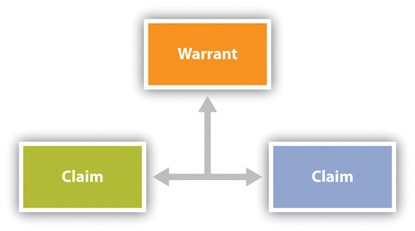
Components of an Argument
The quality of your evidence often impacts the strength of your warrant, and some warrants are stronger than others. A speaker could also provide evidence to support their claim advocating for a national ban on texting and driving by saying, “I have personally seen people almost crash while trying to text.” While this type of evidence can be persuasive, it provides a different type and strength of warrant since it is based on personal experience. In general, anecdotal evidence from personal experience would be given a weaker warrant than evidence from a national research report, such as one conducted by Transport Canada.
The same process applies in the Canadian legal system when a judge evaluates the connection between a claim and evidence. If someone steals my car, I could say to the police, “I’m pretty sure Alex did it because when I saw them the other day, they avoided eye contact, which proves they’re guilty.” A judge faced with that evidence is unlikely to issue a warrant for Alex’s arrest. However, fingerprint evidence from the steering wheel that has been matched with a suspect is much more likely to warrant an arrest.
As you put together a persuasive argument, you act as the judge. You can evaluate arguments that you come across in your research by analyzing the connection (the warrant) between the claim and the evidence. If the warrant is strong, you may want to highlight that argument in your speech. You may also be able to point out a weak warrant in an argument that goes against your position, which you could then include in your speech. Every argument starts by putting together a claim and evidence, but arguments grow to include many interrelated units.
Choosing a Persuasive Speech Topic
As with any speech, topic selection is important and is influenced by many factors. Good persuasive speech topics are current, relevant to society, and encourage critical discussion. If your topic is being discussed on television, in newspapers, on social media, or around your family’s dinner table, then it is a current topic. For example, a persuasive speech advocating for universal access to affordable housing in Canada would be highly relevant today, given the ongoing housing crisis. However, a speech encouraging people to wear seat belts would have had more urgency in the 1970s, when seat belt laws were first being implemented, rather than today when compliance is high.
Many current topics are also controversial, which is what draws attention from the media and citizens. A speech encouraging people to recycle or donate blood is unlikely to be controversial, as the benefits of both are widely accepted. However, arguing that the restrictions on blood donation by men who have had sexual relations with men should be lifted is a more controversial topic in Canada. Controversial does not mean inflammatory; an inflammatory topic provokes strong emotional reactions without contributing to meaningful dialogue. Selecting an extremist or highly provocative topic without substance can damage your credibility and make it difficult to achieve your speech goals.
You should also choose a topic that is important to you and has broader social implications. As we have discussed in this book, communication is a powerful tool for societal change. Therefore, public speaking should be used as an opportunity to engage meaningfully with important issues. A speech arguing that Sidney Crosby is the best hockey player in the world may be of great personal interest but does not carry the same societal significance as a discussion on the impact of climate change policies in Canada.
Additionally, selecting a topic that aligns with your interests and expertise will enhance your delivery and credibility. If you are an education major, a persuasive speech on increasing public education funding in Canada may be more meaningful than one on capital punishment. If there are topics that evoke strong emotional reactions in you, it may be wise to approach them cautiously in an academic or professional setting to maintain composure and effectiveness as a speaker.

Choosing such topics may interfere with your ability to deliver a speech in a confident and ethical manner. You want to be passionate about your topic, but you also want to present it in a way that encourages people to listen and engage with you. Most audiences disengage from speakers who appear too ideologically rigid and dismiss them as extreme or unbalanced.
You also want to ensure that your topic is genuinely persuasive. Draft your thesis statement as an “I believe” statement so your stance on an issue is clear. Think of your main points as reasons that support your thesis. Many students struggle with persuasiveness when they fail to structure their main points as clear supporting reasons. Identifying opposing arguments is also a useful exercise to strengthen your position. If you can clearly identify a counterargument and its supporting reasons, then your topic is debatable and well-suited for persuasion.
Tips for Choosing a Persuasive Speech Topic
- Choose a topic that is current.
- Not current: People should wear seat belts.
- Current: Canada should strengthen penalties for texting while driving.
- Choose a topic that is controversial.
- Not controversial: People should recycle.
- Controversial: Canada should mandate nationwide composting programs.
- Choose a topic that meaningfully impacts society.
- Less impactful: Hockey is the best sport in Canada.
- Impactful: Universities should implement mandatory mental health days for students.
- Write a thesis statement that is clearly argumentative and states your stance.
- Unclear thesis: Homeschooling is common in Canada.
- Clear, argumentative thesis with stance: Homeschooling does not provide the same benefits as traditional education and should be subject to stricter government oversight.
Adapting Persuasive Messages
Effective speakers consider their audience throughout the speech-making process. Because persuasive messages aim to directly influence listeners, audience adaptation becomes even more crucial. If possible, gauge your audience’s stance on your thesis in advance. One approach is to read thesis statements aloud and ask listeners to indicate whether they agree, disagree, or feel neutral. It’s unlikely you’ll have a homogenous audience—some will support your position, some will oppose it, and others will be undecided. As a result, you’ll need to employ different persuasive strategies to engage each group.
For audience members who already agree with your proposition, your goal should be to reinforce their support and encourage action. Since they likely have some background knowledge, focus on providing lesser-known insights that strengthen their commitment. Instead of persuading them to change their stance, move them from agreement to action with a clear, specific call to action that capitalizes on their motivation in the moment.
Neutral audience members typically fall into one of two categories: (1) those who are uninformed and (2) those who don’t perceive the topic as relevant to them. In both cases, your goal is to cultivate interest and concern. Uninformed listeners may need foundational background information before they can form an opinion. For those who believe the issue doesn’t affect them, emphasize relevance through compelling examples, relatable narratives, and concrete evidence. Speakers who choose niche or unfamiliar topics will need to work harder to establish relevance, but neutral audiences offer the greatest potential for persuasion—small shifts in understanding can move them toward agreement.
When addressing an audience that disagrees with your proposition, focus on credibility and incremental change. A hostile audience may be quick to dismiss a speaker who appears unprepared or lacks strong evidence. Establishing credibility—through well-researched arguments, confident delivery, and fair-minded reasoning—is essential to gaining their trust. Your goal should be small but meaningful shifts in perspective rather than a complete reversal of opinion. Additionally, finding common ground with your audience can create a foundation for persuasion, making them more receptive to your message.

Determining Your Proposition
The proposition of your speech establishes its overall direction and aligns with your speech goal. Persuasive speeches generally fall into one of three categories: propositions of fact, value, or policy. While a speech may incorporate elements of all three, its primary proposition is usually determined by its specific purpose and thesis statement.
- Propositions of fact focus on proving that something is or isn’t true.
- Propositions of value argue that something is good or bad, right or wrong, desirable or undesirable.
- Propositions of policy advocate that something should or shouldn’t be done.
Since most persuasive topics can be framed in multiple ways, it’s helpful to identify your proposition early, as it will shape your research and argumentation. The following examples illustrate how the same topic—global warming—can be framed under each type of proposition:
- Proposition of fact: Global warming is caused by increased greenhouse gases related to human activity.
- Proposition of value: America’s disproportionately high pollution levels compared to other countries are unethical.
- Proposition of policy: Stricter emission regulations should be imposed on individual vehicles.
The type of proposition you choose will influence your supporting materials:
- Propositions of fact rely on objective evidence and logical reasoning to establish credibility.
- Propositions of value often involve ethical appeals and expert or lay testimony to influence audience perception.
- Propositions of policy typically require research into existing laws, policies, and proposed legislation to build a case for action.
By clearly defining your proposition, you ensure a focused and compelling persuasive speech.
“Getting Critical”
Persuasion and Masculinity
The traditional view of rhetoric, originating in ancient Greece and continuing to shape contemporary perspectives on persuasion, has been critiqued for its Western and masculine biases. Traditional persuasion has been associated with values such as domination, competition, and change—qualities that some scholars argue can be coercive or even violent (Gearhart, 1979).
As an alternative, communication scholars have proposed invitational rhetoric, which differs from traditional persuasive approaches that seek to “win over an opponent or advocate the correctness of a single position in a complex issue” (Bone et al., 2008). Instead, invitational rhetoric fosters dialogue aimed at mutual understanding rather than victory. This model creates a communicative space where growth and change are possible but not required for one side to “win” an argument. Rather than positioning perspectives in opposition, it acknowledges that each communicator holds a valid standpoint while still allowing for the exchange of alternative viewpoints (Ryan & Natalle, 2001).
Three key principles define invitational rhetoric: safety, value, and freedom.
- Safety ensures that both speakers and audience members feel secure in expressing their ideas without fear of ridicule or dismissal.
- Value affirms that each participant is worthy of recognition and encourages individuals to step outside their own perspectives to better understand others.
- Freedom means that communicators do not impose limitations on others’ thinking or choices, allowing open and unrestricted discussion (Bone et al., 2008).
Importantly, invitational rhetoric does not claim that all persuasion is violent. Rather, it highlights the need to critically examine instances where persuasion may be coercive and considers alternative approaches that foster more civil discourse. By encouraging openness to diverse perspectives, invitational rhetoric has the potential to enhance communication in society. Instead of framing discussions as “us vs. them” or reducing issues to binary categories of right and wrong, this approach embraces the complexity of human perspectives (Bone et al., 2008).
Activity 5: Personal Reflection Journal – Reflection Question 2
Please answer the following reflection questions in any format you like (such as in writing, a video, note form, or a drawing). Save your reflection responses in one large file so you can refer to them later in the course if needed. Please read the text after you have completed the reflection question activity.
Reflection Question 2:
Choose one of the following questions:
- What is your response to the claim that persuasion includes Western and masculine biases?
- What are some strengths and weaknesses of the proposed alternatives to traditional persuasion?
- In what situations might an invitational approach to persuasion be useful? When might a traditional model be more effective?
This activity is adapted from 11.2: Persuasive Speaking which is shared under a CC BY-NC-SA 3.0 license and was authored, remixed, and/or curated by Anonymous via source content that was edited to the style and standards of the LibreTexts platform. In this revised version, we added and removed content, and reworded information to suit this course.
Organizing a Persuasive Speech
Effective persuasive speeches require strategic organization to engage an audience and encourage action. While many organizational patterns apply to different types of speeches, certain structures are particularly useful for persuasion. The choice of organization depends on the topic, audience, and specific goal of the speech.
Some persuasive topics work well with a topical organization pattern, in which the subject is divided into logical categories or themes. When using this approach, speakers should consider primacy and recency. Primacy places the strongest argument first, based on the idea that audiences tend to remember and prioritize what they hear at the beginning. This strategy is especially useful when addressing a skeptical or resistant audience, as it presents compelling evidence early to establish credibility. Recency, on the other hand, places the most persuasive argument last, reinforcing a call to action and leaving a lasting impression. For example, a speech on environmental regulations might begin with an overview of climate change, introduce key evidence early to establish urgency, and conclude with a compelling call to action.
The problem-solution pattern is particularly effective for speeches that advocate for change. In this structure, the speaker first presents evidence of a problem and then proposes a solution supported by reasoning and evidence. Some variations include:
- Problem–failed solution–proposed solution, in which ineffective past approaches are addressed before introducing a viable alternative.
- Problem-solution combined with cause-effect, which first explores the causes and consequences of an issue before presenting a solution.
For example, a speech on prison overcrowding in Canada might argue that expanding rehabilitation programs for nonviolent offenders is a more effective solution than simply building more prisons.
The cause-effect pattern is useful when examining the relationship between causes and consequences, particularly in cases where these connections may be debated. A speech structured this way may:
- Present a cause and demonstrate its effects.
- Start with an issue and trace it back to its root causes.
- Explore multiple causes leading to a single effect.
- Show how one issue results in multiple consequences.
A speech on prison overcrowding, for instance, might argue that it leads to increased violence among inmates and fewer resources for rehabilitation, highlighting the broader social consequences of the issue.
A particularly effective structure for persuasive speaking is Monroe’s Motivated Sequence, a five-step process designed to inspire action:
- Attention: Capture the audience’s interest by making the topic relevant through storytelling, statistics, or rhetorical questions.
- Need: Establish that the issue is significant and requires action by presenting compelling evidence.
- Satisfaction: Propose a clear and feasible solution to the problem, supported by logical reasoning.
- Visualization: Help the audience picture the benefits of adopting the solution or the negative consequences of inaction.
- Action: Provide specific steps the audience can take to engage with the issue or implement the proposed solution.
For example, a speech on elder abuse might open with a compelling story about mistreatment in a care facility, establish the lack of legal protections for seniors, propose stronger reporting laws, illustrate how these changes would improve lives, and conclude by urging the audience to contact their representatives in support of stricter regulations.
By carefully selecting an organizational pattern that aligns with the topic and audience, speakers can enhance the impact of their persuasive messages and encourage meaningful engagement with their ideas.
Key Takeaways
- Arguments consist of claims supported by evidence, with a warrant providing the underlying justification that connects them. Stronger warrants make arguments more persuasive.
- Effective persuasive speech topics are current, relevant, and meaningful to both the speaker and society. They should be controversial enough to engage the audience but not inflammatory.
- Speakers should adapt their persuasive approach based on the audience’s stance toward the proposition:
- When the audience agrees, focus on reinforcing their position and encouraging action.
- When the audience is neutral, provide background information and demonstrate the relevance of the issue.
- When the audience disagrees, establish credibility, build common ground, and address counterarguments.
- Persuasive speeches use three types of propositions:
- Propositions of fact argue that something is true or false.
- Propositions of value assess whether something is good or bad, right or wrong, or desirable or undesirable.
- Propositions of policy advocate for specific actions or changes.
- Persuasive speeches can follow different organizational patterns, including:
- Problem-solution, which presents an issue and proposes a way to address it.
- Cause-effect, which explains the relationship between causes and consequences.
- Cause-effect-solution, which links causes to consequences before offering a solution.
- Monroe’s Motivated Sequence, which follows a structured five-step approach to inspire action.
Choosing the right organizational strategy helps speakers structure their arguments effectively and enhance their persuasive impact.
Activity 6: Interactive – Audio Recording
Please complete the following interactive activity.
- Read the instructions for your persuasive speech assignment.
- Narrow down your topic to just a few sentences.
- Record yourself describing your topic.
- Listen to your recording
- Is your topic truly a persuasive speech? To figure out if your topic is actually persuasive and not informative, consider the claims, arguments, and evidence that you might use in your argument.
Media Attributions
Hryshchenko, V. (2019, December 28). Three crumpled yellow papers on green surface surrounded by yellow lined papers [Photograph]. Unsplash. https://unsplash.com/photos/three-crumpled-yellow-papers-on-green-surface-surrounded-by-yellow-lined-papers-V5vqWC9gyEU
Kehmeier, A. (2020, January 6). View of two persons hands [Photograph]. Unsplash. https://unsplash.com/photos/view-of-two-persons-hands-lyiKExA4zQA
References
Anonymous. (n.d.).11.2: Persuasive Speaking. In Communication in the Real World – An Introduction to Communication Studies. LibreTexts. https://socialsci.libretexts.org/Bookshelves/Communication/Introduction_to_Communication/Communication_in_the_Real_World_-_An_Introduction_to_Communication_Studies/11%3A_Informative_and_Persuasive_Speaking/11.02%3A_Persuasive_Speaking
Bone, J. E., Griffin, C. L., & Linda Scholz, T. M. (2008). Beyond traditional conceptualizations of rhetoric: Invitational rhetoric and a move toward civility. Western Journal of Communication, 72, 436.
Gearhart, S. M. (1979). The womanization of rhetoric. Women’s Studies International Quarterly 2, 195–201.
Ryan, K. J., & Natalle, E. J. (2001). Fusing horizons: Standpoint hermenutics and invitational rhetoric. Rhetoric Society Quarterly, 31, 69–90.
Transport Canada. (2020). Road Safety in Canada 2020. https://tc.canada.ca/sites/default/files/2023-01/Road_Safety_in_Canada_2020_EN.pdf