Topic 4: Self-Disclosure and Interpersonal Communication
Activity 11: Reading – Self-Disclosure and Interpersonal Communication
Please read the following text which addresses self-disclosure and interpersonal communication.
This activity is adapted from 6.4: Self-Disclosure and Interpersonal Communication which is shared under a CC BY-NC-SA 3.0 license and was authored, remixed, and/or curated by Anonymous via source content that was edited to the style and standards of the LibreTexts platform. In this revised version, we have added and removed content, and reorganized information to suit the purposes of our course.
Self-Disclosure and Interpersonal Communication
Self-disclosure plays a crucial role in developing and maintaining interpersonal relationships. When it goes well, self-disclosure can enhance connection and intimacy, and foster deeper relationships. However, poorly timed or inappropriate self-disclosure can result in embarrassment, discomfort, or even the decline of a relationship. To navigate self-disclosure effectively, it is essential to understand the theories and processes accompanying it.
What Is Self-Disclosure?
Self-disclosure is the deliberate sharing of personal information with another person. This can be done verbally or nonverbally. The key aspect of self-disclosure is intention; it is a conscious act to reveal something about oneself. It doesn’t have to be profound: a simple mention of your hometown or favourite hobby can count as self-disclosure and serve as an important initial step in forming connections. For instance, sharing your major with a classmate on the first day of class might not feel risky, but it can lead to deeper levels of disclosure and friendship over time.

Theories of Self-Disclosure
Several theories provide a framework for understanding how self-disclosure works in interpersonal relationships:
- Social Penetration Theory
According to social penetration theory, self-disclosure is like peeling back the layers of an onion—it occurs gradually, with the depth and breadth of information increasing as a relationship progresses. Depth refers to how intimate or sensitive the disclosed information is, while breadth relates to the range of topics discussed. For example, in a new friendship, you might start with surface-level topics like hobbies (breadth) and gradually move to more personal matters like family or romantic relationships (depth). This theory highlights the reciprocal nature of self-disclosure: as one person shares more, the other typically does the same, building mutual trust. - Dialectical Tensions
The theory also introduces the concept of dialectical tensions, when individuals must balance conflicting needs, such as the desire for openness versus the need for privacy. Navigating this tension requires careful decision-making about what, when, and how much to share. Sharing too much too soon might overwhelm the other person, while withholding too much can hinder relationship development.
Activity 12: Personal Reflection Journal – Reflection Question 8
Please answer the following reflection questions in any format you like (such as in writing, a video, note form, or a drawing). Save your reflection responses in one large file so you can refer to them later in the course if needed. After you complete the reflection question, please continue reading the text.
Reflection Question 8:
This activity is adapted from 6.4: Self-Disclosure and Interpersonal Communication which is shared under a CC BY-NC-SA 3.0 license and was authored, remixed, and/or curated by Anonymous via source content that was edited to the style and standards of the LibreTexts platform. In this revised version, we have added and removed content, and reorganized information to suit the purposes of our course.
- Social Comparison Theory
Social comparison theory posits that we disclose information to compare ourselves with others, evaluating our own traits and abilities. This comparison can affect our self-esteem and help us determine our standing in social contexts. For instance, discussing academic performance with classmates allows us to gauge where we stand relative to our peers.
The Johari Window
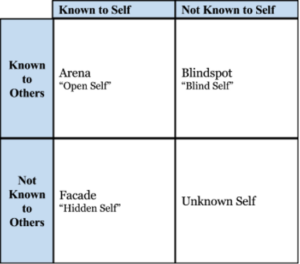
The Johari Window, developed by Joseph Luft and Harrington Ingham, provides a visual framework for understanding self-disclosure. Imagine a window with four quadrants:
- Open Area: Information known to both you and others. This includes what you willingly share, like your name or interests.
- Hidden Area: Information known to you but not to others, such as personal fears or secrets. As relationships develop, information from this quadrant may move to the Open Area through self-disclosure.
- Blind Area: Information others know about you that you are unaware of, like certain habits or traits. Seeking feedback can help reduce this blind spot.
- Unknown Area: Information unknown to both you and others, such as untapped talents or unknown fears. Self-exploration and new experiences can bring some of this information to light.
The Johari Window emphasizes the importance of feedback and self-exploration in building self-awareness and deeper connections.
The Process of Self-Disclosure
Engaging in self-disclosure involves multiple decisions regarding what, when, where, and how to share information. These decisions are influenced by several factors:
What to Disclose: Information can be categorized into observations, thoughts, feelings, and needs:
- Observations: Facts about your life, like where you live
- Thoughts: Judgments or opinions about your experiences
- Feelings: Emotional reactions, like happiness or disappointment
- Needs: Desires or wants, such as asking for help or seeking companionship
People often begin with observations and thoughts and move to feelings and needs as the relationship deepens.
When to Disclose: The timing of self-disclosure can significantly impact its effectiveness. Consider when in a conversation to bring up sensitive topics:
- Early disclosure can ensure there’s time to discuss.
- Mid-conversation disclosure allows you to gauge the other person’s mood.
- Late disclosure can be strategic if you want to limit exposure to potential negative reactions.
Where to Disclose: The environment can affect the success of self-disclosure. A quiet, private setting might be more appropriate for sharing intimate details, while a public space might limit how personal you are willing to get.
How to Disclose: Choosing the right channel is crucial. Face-to-face disclosure offers immediate feedback and richer context due to nonverbal cues, while mediated channels (like text or email) allow more control over wording but lack nonverbal elements.
Activity 13: Personal Reflection Journal – Reflection Question 9
Please answer the following reflection questions in any format you like (such as in writing, a video, note form, or a drawing). Save your reflection responses in one large file so you can refer to them later in the course if needed. After you complete the reflection question, please continue reading the text.
Reflection Question 9:
Think about a time when you shared something important through a mediated channel (such as direct message or text). What were the advantages or disadvantages compared to a face-to-face conversation?
This activity is adapted from 6.4: Self-Disclosure and Interpersonal Communication which is shared under a CC BY-NC-SA 3.0 license and was authored, remixed, and/or curated by Anonymous via source content that was edited to the style and standards of the LibreTexts platform. In this revised version, we have added and removed content, and reorganized information to suit the purposes of our course.
Self-Disclosure and Social Media
In today’s digital world, social media platforms like Snapchat and Instagram offer unique spaces for self-disclosure. Online self-disclosure can reach a broad audience, and individuals often share a mix of personal and public information. However, privacy concerns and the potential for misinterpretation make online disclosure riskier. Research shows that younger generations are more comfortable blending private and public selves online, while older generations may prefer more distinct boundaries.
The risks of online self-disclosure include unintended audiences, loss of control over shared content, and possible negative consequences for future job prospects or personal relationships. Therefore, managing privacy settings and considering the appropriateness of content are essential.

Effects of Self-Disclosure on Relationships
The outcome of self-disclosure depends heavily on the response it receives:
- A positive reaction can increase relational closeness, trust, and intimacy.
- A negative reaction can lead to embarrassment, discomfort, or relational strain.
- The receiver’s interpretation—whether they view the disclosure as a sign of trust or as inappropriate—plays a crucial role in how the interaction affects the relationship.
Positive outcomes of self-disclosure include a sense of relief, deeper relational bonds, and even physical health benefits. However, negative outcomes like betrayal or gossip can lead to trust issues or relationship deterioration.
Key Takeaways
- Self-disclosure is a strategic process that plays a crucial role in interpersonal relationships.
- Social penetration theory describes self-disclosure as increasing in depth and breadth over time, while the Johari Window provides a framework for understanding what is known and unknown in relationships.
- Decisions about what, when, where, and how to disclose are influenced by the context and the nature of the relationship.
- Positive reactions to self-disclosure can lead to deeper intimacy, while negative reactions can have the opposite effect.
- Managing privacy and disclosure is especially critical in digital environments where audiences may be unpredictable.
Media Attributions
Jarritos Mexican Soda. (2021, July 15). 2 women sitting on brown wooden bench [Photograph]. Unsplash. https://unsplash.com/photos/2-women-sitting-on-brown-wooden-bench-kFEb8yigiuQ
Kemy, R. (2019, November 19). Man in train holding smartphone [Photograph]. Unsplash. https://unsplash.com/photos/man-in-train-holding-smartphone-oqY09oVTa3k
Spanton. (2015). The Johari Window. Wikimedia Commons, https://commons.wikimedia.org/wiki/File:Johari_window.png
References
Anonymous. (n.d.). Section 6.4: Self-Disclosure and interpersonal communication. In Communication in the real world: An introduction to communication studies. LibreTexts. Retrieved from https://socialsci.libretexts.org/Bookshelves/Communication/Introduction_to_Communication/Communication_in_the_Real_World_-_An_Introduction_to_Communication_Studies/06%3A_Interpersonal_Communication_Processes/6.04%3A_Self-Disclosure_and_Interpersonal_Communication
Derlega, V. J., Metts, S., Petronio, S., & Margulis, S. T. (1993). Self-disclosure. Sage.
Greene, K., Derlega, V. J., & Mathews, A. (2006). Self-disclosure in personal relationships. In A. L. Vangelisti & D. Perlman (Eds.), The Cambridge handbook of personal relationships (pp. 412–413). Cambridge University Press.
Hargie, O. (2011). Skilled interpersonal interaction: Research, theory, and practice. Routledge.
Jiang, L. C., Bazarova, N. N., & Hancock, J. T. (2011). The disclosure-intimacy link in computer-mediated communication: An attributional extension of the hyperpersonal model. Human Communication Research, 37(1), 63.
Jourard, S. (1964). The transparent self. Van Nostrand Reinhold.
Kornblum, J. (2007, October 23). Privacy? That’s old-school: Internet generation views openness in a different way. USA Today, 1D.
Luft, J. (1969). Of human interaction. National Press Books.
Nealy, M. J. (2009). The new rules of engagement. Diverse: Issues in Higher Education, 26(3), 13.
Spanton. (2015). The Johari Window. Wikimedia Commons, https://commons.wikimedia.org/wiki/File:Johari_window.png
Stefanone, M. A., & Lakaff, D. (2009). Reality television as a model for online behavior: Blogging, photo, and video sharing. Journal of Computer-Mediated Communication, 14(4), 964–987.