Topic 4: Postmodern and Post-Structural Media Theory
Activity 7: Reading – Postmodern and Post-Structural Media Theory
Please read the following text which introduces you to postmodern and post-structural media theory.
This activity is adapted from 8.4: Postmodern and Post-Structural Media Theory in Communication Literary: An Introduction to Communication Studies by Dr. Victoria Newsom and Desiree Ann Montenegro, MA which is shared under a CC BY-NC-SA 4.0 license. Changes for readability, to add Canadian context, and to add illustrations as cited from other sources.
Another significant shift in Media Studies toward critical approaches was the incorporation of postmodern and post-structural theories (Huyssen, 1984; Jameson, 1984; Lyotard, 1979/1984; McRobbie, 1994; Storey, 2018). These theoretical perspectives resist fixed definitions, structure, and permanence, aligning with their core objective of challenging established systems of meaning. Rather than providing clear-cut frameworks, postmodernity encourages fluidity, multiple interpretations, and alternatives to rigid conceptual boundaries (Jameson, 1984a, 1984b, 1991; Lyotard, 1979/1984; McRobbie, 1994; Storey, 2018).
For instance, postmodern scholar Huyssen (1984) highlights this resistance to definition:
I will not attempt here to define what postmodernism is. The term ‘postmodernism’ itself should guard us against such an approach as it positions the phenomenon as relational. Modernism as that from which postmodernism is breaking away remains inscribed into the very word with which we describe our distance from modernism…. postmodernism’s critical dimension lies precisely in its radical questioning of those presuppositions which linked modernism and the avant-garde to the mindset of modernization. (pp. 10-11).
Rather than attempting to define postmodernism and post-structuralism, scholars in these fields focus on the relationships between cultural artifacts and power structures, media and ideology, and audience interpretations of postmodern texts (Eagleton, 1985; Foucault, 1969/1972; Huyssen, 1984; Jameson, 1984a, 1984b, 1991; Lyotard, 1979/1984; McRobbie, 1994; Storey, 2018). Postmodern theorists also interrogate whether mediated communication actively shapes reality, reinforcing and structuring perceptions of the “real” world, or whether media merely reflects existing truths and ideologies. This ongoing tension remains central to postmodern critiques of mass communication and culture.
The Postmodern Era: A Response to Modernism
The concepts of modernism and postmodernism are widely debated and analyzed across various disciplines. Generally, postmodernism is understood as a contrasting response to modernism (Huyssen, 1984; Jameson, 1984a; McRobbie, 1994; Storey, 2018). While modernism seeks to understand truth through rational structures and component realities, aiming toward a Platonic ideal beyond human experience (Huyssen, 1984), postmodernism questions whether a stable reality exists at all. It challenges the idea of a singular, objective truth, instead suggesting that multiple, conflicting truths can coexist (Lyotard, 1979/1984).
Discussions of modernism and postmodernism typically refer to one or more of the following:
- A historical era (e.g., modernism as a response to industrialization; postmodernism as a response to late capitalism).
- An aesthetic style or artistic sensibility (e.g., modernist literature focusing on fragmentation; postmodern media embracing pastiche and intertextuality).
- A theoretical framework for interpreting meaning (e.g., modernist structuralism vs. postmodern deconstruction).
Theorist Angela McRobbie (1994) argues that postmodernism and postmodernity function as sites of negotiation between hegemonic power structures and social change. Both postmodern theory and postmodern media serve as platforms where dominant ideologies can be challenged and alternative perspectives can emerge (Mumby, 1997).
Modernism, Postmodernism, and the Political Context
Both modernism and postmodernism arose, in part, as responses to the global political complexities of their respective eras. Industrialization, shifting notions of empire, increased reliance on communication technologies, and the World Wars all contributed to a growing need for critique and reinterpretation of the world (Foucault, 1969/1972; Jameson, 1984a, 1984b, 1991; Lyotard, 1979/1984).
Modernists—the artists, writers, and thinkers of the early 20th century—responded to these transformations by seeking order and control. Their work was often futurist in orientation, striving to construct utopian ideals that mirrored Platonic idealism and earlier social movements (Eagleton, 1985; Mumby, 1997). They believed in progress and in the power of rationality and structure to create a better world.
Postmodernists, in contrast, reacted against these assumptions, questioning whether grand narratives of progress and universal truths could be sustained in an increasingly fragmented and globalized world. As a result, postmodern theory and postmodern media often highlight ambiguity, contradiction, and multiplicity of perspectives, resisting the structured clarity sought by modernist thinkers.

In contrast to modernism, postmodernism emerged as a reaction against modernist values and idealism. These theoretical frameworks developed in response to modernist philosophy and scientific positivism, challenging the assumption that knowledge is built upon objective truths and linear progress (Dewolf, 1946; Eagleton, 1985; Mumby, 1997).
Modernism, influenced by evolutionary theories, focused on progress and the pursuit of utopian ideals. Its scholars emphasized the role of scientific positivism, which asserts that sensory data can be used as empirical evidence to uncover an objective reality. Positivism relies on scientific methods to seek out universal truths, assuming that knowledge is cumulative and can lead society toward a perfected future.
Postmodernism, by contrast, rejects the idea of a singular, stable truth and challenges the notion that human societies are progressing toward an ultimate state of perfection (Lyotard, 1979/1984). Postmodern theorists argue that reality is fragmented and constructed, shaped by language, culture, and media rather than objective facts.
Lyotard and the Crisis of Truth
In The Postmodern Condition, Jean-François Lyotard (1979/1984) critically examines the mythic nature of stable truth, questioning how individuals consume mediated and politicized realities. He introduces the concept of the metanarrative—a grand, overarching story that claims to explain and structure human history. Lyotard challenges audiences to consider whether the pursuit of a centralized, ideal truth obscures more complex and diverse realities hidden beneath dominant narratives. His work underscores the postmodern skepticism toward universal explanations and the power structures that sustain them.
Activity 8: Personal Reflection Journal – Reflection Question 4
Please answer the following reflection questions in any format you like (such as in writing, a video, note form, or a drawing). Save your reflection responses in one large file so you can refer to them later in the course if needed. Please continue to read the text after you have completed the reflection question activity.
Reflection Question 4:
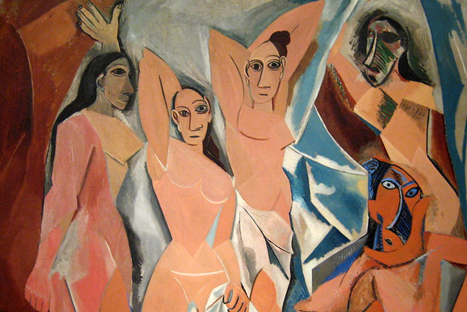
Postmodernism challenges the idea of a singular, stable truth and instead argues that multiple truths, values, and identities are constantly shifting and intersecting. Postmodern artists, such as Picasso, reject traditional structures and forms, reflecting this fragmented and evolving reality.
Identify a contemporary artist, filmmaker, musician, or social media creator whose work similarly challenges conventional norms or structures? How does their work reflect postmodern ideas of fluid identity, multiple truths, or media-driven realities?
Use concepts from Lyotard, McRobbie, or other postmodern theorists to support your response.
This activity is adapted from 8.4: Postmodern and Post-Structural Media Theory in Communication Literary: An Introduction to Communication Studies by Dr. Victoria Newsom and Desiree Ann Montenegro, MA which is shared under a CC BY-NC-SA 4.0 license. Changes for readability, to add Canadian context, and to add illustrations as cited from other sources.
Post-Structural Theory and Popular Culture
Post-structuralism emerged alongside postmodernism as a response to modernism and structuralism—the belief that society operates within a stable and predictable structure. Post-structuralist theorists challenge this assumption, arguing that social structures are rhetorically constructed rather than naturally occurring. Because of this, there is no single, positivist truth about these structures, and they are therefore subject to change (Baudrillard, 1981/1994; Butler, 1990; Derrida, 1997; Foucault, 1969/1972).
Most post-structuralists advocate for freeing ourselves from oppressive structures by redefining and renegotiating social meanings. While both postmodernism and post-structuralism examine popular culture through a Marxist lens—viewing media as a force for social normalization—they also depart from earlier Frankfurt School theorists by recognizing popular culture as a space where oppositional ideas can emerge and be negotiated.
Jameson and the Postmodern Condition
As French postmodern theories were translated and adapted by American scholars, the study of popular media increasingly focused on the clash between producer-driven values and audience interpretations. Fredric Jameson (1984a) argued that we now live in a postmodern world, shaped by key characteristics such as:
- Pastiche: Popular culture continuously builds on and references itself, often blurring historical and ideological distinctions.
- The Crisis of History and Ideology: Lived experience no longer aligns with the way history and ideology are traditionally taught and understood.
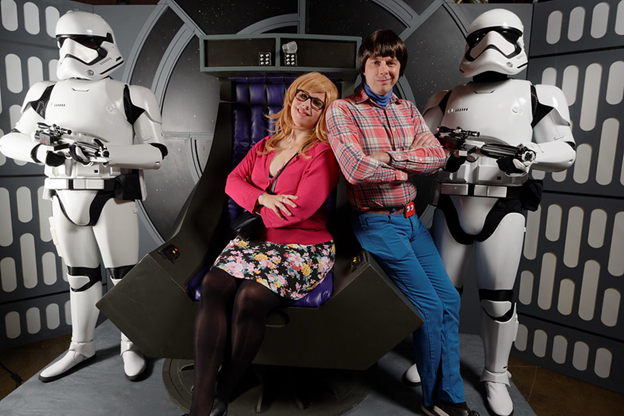
For example, consider an episode of Family Guy. The show relies heavily on layered popular culture references, requiring viewers to recognize multiple interwoven media influences in a single episode. This pastiche—the endless recycling and remixing of cultural artifacts—becomes a form of cultural critique, exposing and deconstructing rhetorically constructed social “truths”. In this way, Family Guy and other postmodern media illustrate what Jameson saw as a broader trend in American popular culture: a hyper-referential media environment where meaning is constantly renegotiated.
Note how the forms and popular culture norms are adapted, copied, parodied, altered, and re-created in the following example:
Post-structuralism also critically examines the role of power in shaping knowledge and meaning. Michel Foucault’s Archaeology of Knowledge (1969/1972) presents a post-structural argument by illustrating how the structure of knowledge shifts throughout history. By analyzing the power structures that govern the production of knowledge, we can begin to understand how these relationships empower certain groups while oppressing others. Foucault contends that everything has a history—including history itself—and that the dominant narratives we accept as truth must be interrogated for the power dynamics they conceal. A key focus in post-structural media theory is how media serves as a tool for those in power to reinforce and maintain existing knowledge and power structures.
Another influential post-structural theory used in media analysis is Jacques Derrida’s (1967/1997) deconstruction. Derrida examines how rhetorical constructs—including language, media, and cultural narratives—are deeply embedded in power. He challenges the idea that meaning is determined by authorial intent, arguing instead that meaning is shaped by audience interpretation. According to Derrida, we are not dealing with fixed truths but rather with constructed meanings designed to maintain social order and legitimize the power structures that have been historically established. Media, in this view, does not simply reflect reality but actively participates in shaping the way society understands itself.

Despite the seeming stability of social truths, we have the power to challenge and alter them—particularly when we examine the binary structures that underpin rhetorically constructed systems of power. Ferdinand de Saussure’s (1916/1959) structuralist theory of binary oppositions suggests that meaning is created through contrast between two mutually exclusive terms. Common examples include “male” and “female”, “black” and “white”, “good” and “evil”, and “progressive” and “conservative”.
In social constructionism, these binaries are not neutral; they are tied to systems of power that typically privilege one category over the other. For instance, in a patriarchal society, the concept of “male” is positioned as more dominant or valued than “female”.
Jacques Derrida challenges the rigid nature of these binary structures by arguing that, while they are presented as opposites, they are actually interdependent. Each term exists only in relation to the other. For example, the concept of “male” only has meaning because “female” exists as a contrasting category. Without this binary, we would simply have “person”. By exposing the co-dependence of these terms, Derrida destabilizes the idea that one is inherently more powerful than the other, ultimately calling into question the validity of power structures that rely on such binary oppositions. If these systems are constructed rather than natural truths, they can also be deconstructed and redefined.
Postmodern Media: Challenging Reality and Structure
Rather than striving toward utopian ideals, postmodernism seeks to question the motives, usefulness, and very reality of modernist and systemic ideals. In doing so, postmodern thought often leads to a vision of the future that is dystopian rather than idealistic, where multiple conflicting realities exist and interact simultaneously.
A defining characteristic of postmodernism is its resistance to fixed definitions. To define postmodernism too rigidly would contradict its own fundamental assumptions. Instead, postmodernism thrives on contradictions, paradoxes, and fluidity, rejecting the stability that modernism assumes. It builds on a collective of contrasting values and ideals, ultimately generating a sense of freedom that comes from refusing confining boundaries.
Postmodern media and cultural artifacts reflect this ethos by blending past and present, fiction and reality, high culture and low culture, often in ways that feel disorienting yet familiar. Spaces like the Las Vegas Strip, where landmarks from different cities and historical moments are artificially reconstructed side by side, serve as examples of postmodern pastiche. These spaces blur the line between authenticity and simulation, illustrating the postmodern condition where representation and reality become inseparable.

Jean Baudrillard (1981/1994) explores the concept of hyperreality—a state where mediated reality and lived experience become indistinguishable. In contemporary society, media representations are so pervasive that many individuals struggle to differentiate between events as they exist in the real world and their portrayals in the media. According to Baudrillard, physical or natural truths have been replaced by symbolic truths, as meaning is rhetorically constructed through media representation.
Baudrillard (1987/1988) further argues that society has entered an “ecstasy of communication”, in which media products continuously reproduce and reference each other, leading to an endless cycle of pastiche—a concept also highlighted by Fredric Jameson. This process results in a hyperreal state, where reality itself is shaped more by media narratives than by original experiences.
The Precession of Simulacra
Baudrillard (1981/1994) describes this process as the precession of simulacra, where representations of reality gradually replace and obscure the original. Simulacra are reproductions of objects, events, or experiences that eventually supersede the real, creating a reality that is indistinguishable from its own simulation. In this sense, the simulated version of reality becomes more real than the original.
Similarly, Umberto Eco (1973/1986) critiques this phenomenon, arguing that through mediation and recreation, society is left with “authentic fakes”—representations that feel more real than what they originally referenced.
Baudrillard outlines four stages in the precession of simulacra:
- A faithful image: The representation is believed to be a true reflection of reality.
- Distortion of the original: The original image is seen as flawed or incomplete, leading to nostalgic reinterpretations of the past. (Example: Romanticized versions of history that may never have actually existed).
- Absence of the original: The simulacrum pretends to be real, but we begin to question whether the original ever truly existed.
- Pure simulation: At this stage, connecting the simulacrum to an original truth no longer matters. The simulated version is accepted as the new reality.
Simulated Reality and Cultural Expectations
Baudrillard’s framework can be applied to real-world examples, such as Disney’s Main Street U.S.A. versus the historic reconstruction of a town’s main street. According to Baudrillard, neither version is more “real” than the other. Over time, the repeated reconstructions and idealized versions of the past shape our understanding of what a main street should look like—often overshadowing the historical reality. The expectations we develop from these simulated versions of reality further reinforce how we perceive and reconstruct the past.
The Precession of Simulacra: The American Main Street
Stage 1: The Faithful Image
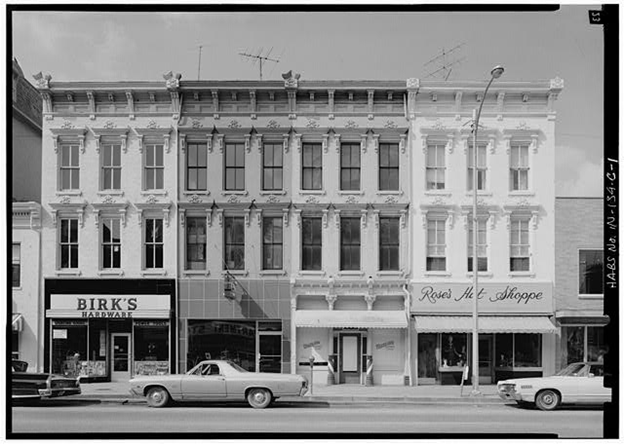
This first image shows Main Street in Madison Indiana, circa 1950. This is one of the towns the U.S. War Office’s interpreted during the Second World War in The Town, a propaganda film meant to remind the Armed Forces of what they were fighting for “back home.” The city of Madison was chosen because it encompassed the values associated with “small town America.”
Stage Two: The Perversion of Reality
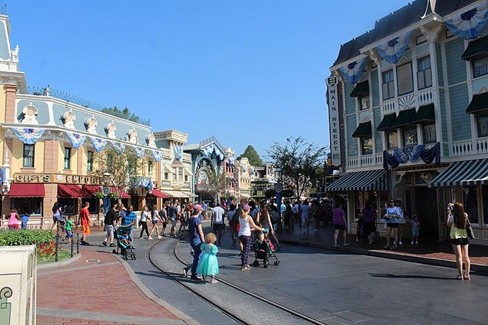
This image depicts Disneyland’s Main Street USA. Walt Disney designed this façade to represent a nostalgic view of Main Streets in America, echoing Norman Rockwell images and the propaganda about towns such as Madison.
This mediation was further mediated on TV shows such as The Wonderful World of Disney.
Stage Three: Absence
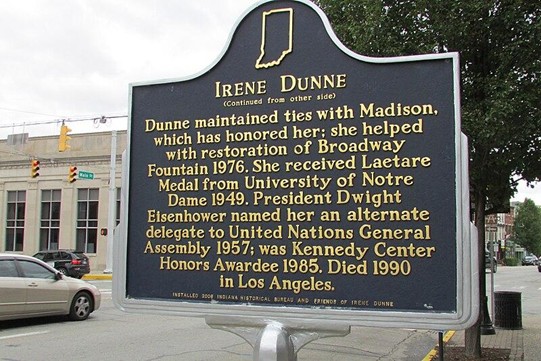
In the 1970s, inspired by Main Street USA in Disneyland and the later one in Walt Disney World, the National Trust for Historic Preservation developed a Main Street Program to preserve Main Street America. Madison was one of three premiere towns chosen. The image above highlights the work of Hollywood actress Irene Dunne, a native of Madison, who donated toward the historic preservation efforts.
Madison’s Main Street was therefore ‘cleaned up’ and ‘redesigned’ to better reflect the National Trust’s interpretation of Main Street America, as influenced by Disney’s Main Street USA.
Stage Four: The Simulation
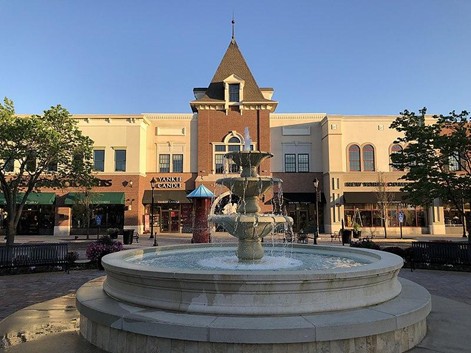
Beginning in the 1980s a new commercial architectural movement began that echoes the National Trust’s Main Street America architectural design ideals. New Urbanism copies small town and city life in America into suburban settings by creating a “Main Street” effect with homes, shops, fountains, and walking areas for homeowners.
Madison continued to re-design itself to imitate the values and ideals presented by Disneyland, The National Historic Trust, and New Urbanism.
This ideal was then copied into The Truman Show, as the new utopian ideal, continuing the cycle of simulation…in the desert of the real.
Activity 9: Interactive – Image Activity
Please complete the following interactive activity. Then, continue to read the course text.
This activity is adapted from 8.4: Postmodern and Post-Structural Media Theory in Communication Literary: An Introduction to Communication Studies by Dr. Victoria Newsom and Desiree Ann Montenegro, MA which is shared under a CC BY-NC-SA 4.0 license. Changes for readability and to add context.
Hyperreality in the Digital Age
As society continues to navigate the digital age, the influence of hyperreality has become even more pervasive. From avatars in virtual spaces to digital economies and social media profiles, our lived experiences are increasingly shaped by media representations. In this environment, what is perceived as real is often constructed through digital interactions and mediated narratives, rather than direct, unmediated experiences.
Scholars in communication studies are increasingly focusing on hyperreality and rhetorical constructions in their mediated forms, analyzing how digital and broadcast media shape public perception. Consider the role of news media—how do programs on Fox News, CNN, CBC, or other networks shape our understanding of reality? Are they reporting on events as they happen, or are they constructing new realities for audiences? If our access to media determines our understanding of global events, does that mean our version of truth is ultimately mediated rather than objective?
This raises a broader question about the nature of reality itself. Is the “real” world portrayed in The Matrix fundamentally different from the “real” world constructed by Orson Welles’ War of the Worlds broadcast? If audiences experience an event through media rather than directly, does it matter whether that event is factually real or simply perceived as real? These questions challenge us to rethink the boundaries between media, truth, and lived experience in an era where hyperreality is more embedded in daily life than ever before.
Media Attributions
Emilipothèse. (2019, January 6). Gray and white robot illustration [Photograph]. Unsplash. https://unsplash.com/photos/gray-and-white-robot-illustration-FTfjMijq-Ws
Jean, B. (2019, May 9). Landscape photography of vehicles parked on side of a street [Photograph]. Unsplash. https://unsplash.com/photos/landscape-photography-of-vehicles-parked-on-side-of-a-street-jNu3ZlPfU5Q
Murray, C. (2018, February 17). Four men standing outside feed and grain store [Photograph]. Unsplash. https://unsplash.com/photos/four-men-standing-outside-feed-and-grain-store-iwfHhOZLVMU
Nvs, B. (2020, November 15). People walking on sidewalk near brown concrete building during daytime [Photograph]. Unsplash. https://unsplash.com/photos/people-walking-on-sidewalk-near-brown-concrete-building-during-daytime-g3CR0UJ1CyM
Paefgen, J. (2020, February 10). City with lights turned on during night time [Photograph]. Unsplash. https://unsplash.com/photos/city-with-lights-turned-on-during-night-time-uxU_jyu9e7U
Pupăză, D. (2021, December 5). A narrow city street with a mountain in the background [Photograph]. Unsplash. https://unsplash.com/photos/a-narrow-city-street-with-a-mountain-in-the-background-vst8XjM9uoY
Sinn, A. (2019, September 25). A heart is shown on a computer screen [Photograph]. Unsplash. https://unsplash.com/photos/a-heart-is-shown-on-a-computer-screen-KgLtFCgfC28
Theme Park Tourist. (2016, August 4). Main Street USA at Disneyland [Photograph]. Wikimedia Commons. https://commons.wikimedia.org/wiki/File:Main_Street_USA_(28772952816).jpg
Tromeur, J. (2021, November 23). A blurry image of a baseball player swinging a bat [Photograph]. Unsplash. https://unsplash.com/photos/a-blurry-image-of-a-baseball-player-swinging-a-bat-EOSHmMbjT8g
XR Expo (2020, June 18). Man in black jacket holding blue and white plastic cup [Photograph]. Unsplash. https://unsplash.com/photos/man-in-black-jacket-holding-blue-and-white-plastic-cup-ipDhOQ5gtEk
References
Baudrillard, J. (1988). The ecstasy of communication (B. Shutze, & C Shutze, Trans.; S. Lotringer, Ed.). Semiotext(e). Original work published 1987.
Baudrillard, J. (1994). Simulacra and simulation (S. F. Glaser, Trans.). University of Michigan Press. Original work published 1981.
Butler, J. (1990). Gender trouble: Feminism and the subversion of identity. Routledge.
de Saussure, F. (1959). Course in general linguistics (W. Baskin, Trans.). Philosophical Library. Original work published 1916.
Derrida, J. (1997). Of grammatology. (G.C. Spivak, Trans.). The Johns Hopkins University Press. Original work published 1967.
Dewolf, L. H. (1946). The New Modernism. The Philosophical Review, 55(5), 600–603.
Eagleton, T. (1985). Capitalism, modernism and postmodernism. New Left Review, 152(1985), 60–73.
Eco, U. (1986). Faith in fakes (W. Weaver, Trans.). Martin Secker & Walberg. Original work published 1973.
Foucault, M. (1972). The archaeology of knowledge and the discourse on language (A. M. Sheridan, Trans.). Pantheon. Original work published 1969 and 1971.
Huyssen, A. (1984). Mapping the postmodern. New German Critique, 33, 5–52.
Jameson, F. (1984a). Postmodernism, or, the cultural logic of late capitalism. New Left Review, 146, 59–92.
Jameson, F. (1984b). The politics of theory: ideological positions in the postmodernism debate. New German Critique, 33, 53–65.
Jameson, F. (1991). Postmodernism, or, the cultural logic of late capitalism. Duke University Press.
Lyotard, J.F. (1984). The postmodern condition: A report on knowledge (G. Bennington, & B. Massumi, Trans.). University of Minnesota Press. Original work published 1979.
McRobbie, A. (1994). Postmodernism and popular culture. Routledge.
Mumby, D. K. (1997). Modernism, postmodernism, and communication studies: A rereading of an ongoing debate. Communication Theory, 7(1), 1–28. https://doi.org/10.1111/j.1468–2885.1997.tb00140.x
Newsom, V. and Montenegro, D.A. (n.d.). 8.4: Postmodern and Post-Structural Media Theory. In Communication Literary: An Introduction to Communication Studies. https://lor.instructure.com/resources/6632a178ac5040948fc971be0511f98c
Storey, J. (2018). Cultural theory and popular culture: An Introduction (8th ed.). Routledge.