Topic 1: Understanding Small Groups
Activity 1: Reading – Understanding Small Groups
Please read the following text which introduces you to the theory and practice of small group communication.
This activity is adapted from 13.1: Understanding Small Groups which is shared under a CC BY-NC-SA 3.0 license and was authored, remixed, and/or curated by Anonymous via source content that was edited to the style and standards of the LibreTexts platform. In this revised version, we have added and removed content, replaced images, and reworded information to suit this course.
Most of the communication skills discussed in this course are designed for dyadic communication, or interactions between two people. While these skills can often be adapted to small group settings, the increased complexity of group interactions requires additional strategies. Small group communication refers to interactions among three or more individuals who are connected by a shared purpose, mutual influence, and a collective identity. This section explores the characteristics, functions, and types of small groups to provide a deeper understanding of their dynamics.
Characteristics of Small Groups
Small groups differ in their characteristics and purposes. While interpersonal communication often focuses on building and maintaining relationships, small group communication is usually oriented toward completing tasks or achieving specific goals. For example, a university study group focusing on math and science, a political campaign team, or a collective of organic farmers each exemplifies a small group with distinct size, structure, identity, and interaction patterns. Despite these differences, all small groups share the defining feature of purposeful collaboration toward a common objective.
Size of Small Groups
The size of a small group can vary depending on its purpose, but there are some general guidelines. A group requires at least three members, as two people form a dyad rather than a group. However, when the number of members exceeds fifteen to twenty, the group may lose its “small group” characteristics, such as close interpersonal connections and efficient communication.
The complexity of group size becomes apparent when considering the number of potential connections between members. In a six-person group, there are fifteen possible connections, while a twelve-person group has sixty-six potential connections. This exponential growth in network complexity can overwhelm members and reduce the group’s ability to function cohesively. Consequently, it is essential to limit group size to what is necessary for achieving its purpose, ensuring that members remain engaged and connected.
Structure of Small Groups
The structure of small groups is influenced by both internal and external factors, shaping how members interact and accomplish tasks.
Internal factors often stem from the characteristics and behaviours of group members. For example, a highly motivated or knowledgeable member may naturally take on a leadership role, initiating decisions about recruiting additional members or assigning roles within the group. Members also contribute to the group’s structure through their preferences, gravitating toward specific roles or advocating for particular procedures and approaches to tasks.
External factors, such as group size, tasks, and resources, also play a crucial role in shaping group structure. Some groups have significant control over these external factors, while others do not. A self-organized weekly book club, for instance, can freely determine its size, membership, and meeting structure. In contrast, a legislative commission tasked with investigating ethical violations in sports organizations may have little control over its size, scope, or member selection, as these elements are dictated by external authorities.
By understanding and balancing these internal and external influences, groups can develop effective structures that support their goals and maintain strong communication.

Group structure is also formed through formal and informal network connections. In terms of formal networks, groups may have clearly defined roles and responsibilities or a hierarchy that shows how members are connected. The group itself may also be part of an organizational hierarchy that links the group to a larger organizational structure. This type of formal network is especially important in groups that have to report to external decision-makers or partners. These external influences may shape the group’s formal network, leaving the group
little or no control over its structure. Conversely, groups have more control over their informal networks, which are connections among individuals within the group and between group members and people outside of the group that aren’t official. For example, a group member’s friend or relative may be able to secure a space to hold a fundraiser at a discounted rate, which helps the group achieve its task. Both types of networks are important because they may help facilitate information exchange within a group and extend a group’s reach to access other
resources.
Size and structure also affect communication within a group (Ellis & Fisher, 1994, p. 57). In terms of size, the more people in a group, the more issues with scheduling and coordination of communication. Remember that time is an important resource in most group interactions and a resource that is usually strained. Structure can increase or decrease the flow of communication. Reachability refers to the way in which one member is or isn’t connected to other group members. For example, the “Circle” group structure in Figure 8.1.1 shows that each group member is connected to two other members. This can make coordination easy when only one or two people need to be brought in for a decision. In this case, Erik and Callie are very reachable by Winston, who could easily coordinate with them. However, if Winston needed to coordinate with Bill or Stephanie, he would have to wait on Erik or Callie to reach that person, which could create delays. The circle can be a good structure for groups who are passing along a task and in which each member is expected to progressively build on the others’ work. A group of scholars coauthoring a research paper may work in such a manner, with each person adding to the paper and then passing it on to the next person in the circle. In this case, they can ask the previous person questions and write with the next person’s area of expertise in mind. The “Wheel” group structure in Figure 8.1.1 shows an alternative organization pattern. In this structure, Tara is very reachable by all members of the group. This can be a useful structure when Tara is the person with the most expertise in the task or the leader who needs to review and approve work at each step before it is passed along to other group members. But Phillip and Shadow, for example, wouldn’t likely work together without Tara being involved.
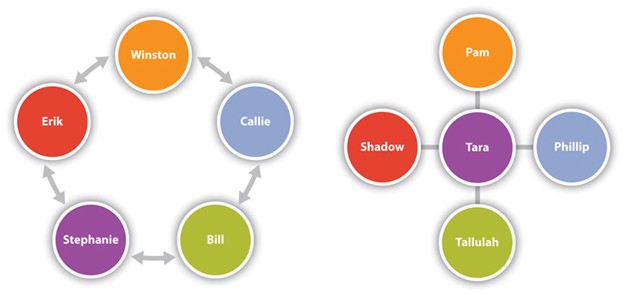
Group Structures and Communication
Group structures influence communication patterns in significant ways. The “wheel” structure is an example of a centralized network, while the “circle” structure represents a decentralized network. Research suggests that centralized groups tend to be faster and more efficient (Ellis & Fisher, 1994, p. 57), but decentralized groups excel at solving complex problems.
In centralized groups, such as the wheel, the person with the most connections (e.g., Person C) often emerges as the leader or gains higher status due to their broad access to information. This central individual can act as a gatekeeper, controlling the flow of information. While this can streamline decision-making, it may also create bottlenecks or overwhelm the central member during complex tasks.
Decentralized groups, like the circle, are better suited for collaborative efforts that are not under strict time constraints. In such groups, leadership is less hierarchical, and information flows more equally, reducing the likelihood of gatekeeping. These structures are often seen in groups prioritizing collaboration over rigid task delegation.
Interdependence in Groups
Small groups are interdependent, meaning members share a common purpose and are mutually affected by each other’s actions. Success or failure of the group depends on the contributions of all members. For example, if one member’s actions cause the group to miss its goal, everyone is impacted. Similarly, if a few members succeed in achieving the goal, the whole group benefits.
This interdependence is often why students dislike group assignments. They may feel a loss of control, as their grades depend on others’ efforts. For example, when some group members miss meetings or fail to contribute, it can derail progress. However, interdependence can also enhance performance and accountability, leading to better outcomes when group members work collaboratively and responsibly.
Shared Identity in Groups
Groups often develop a shared identity, which can be reflected in mission statements, symbols, or traditions. For example, the Girl Scouts’ mission to build “courage, confidence, and character” shapes the identity of both the organization and individual troops.
Shared identity may also emerge from group names, slogans, or activities. At a family reunion, for instance, matching t-shirts, heirloom recipes, and shared stories reinforce a sense of belonging and continuity.
An essential part of shared identity is the distinction between the in-group and out-group. While not all members may equally embrace this identity—some might skip a family reunion or dislike the matching shirts—group cohesion and shared identity often build trust, improve satisfaction, and enhance productivity.
Why We Join Groups
Despite the challenges of group work, people join groups to meet various needs, including instrumental, interpersonal, and identity needs.
Instrumental Needs
Groups often address practical needs by pooling resources or providing access to information. Historically, groups helped humans survive through collective protection and resource sharing. Today, labour unions and advocacy groups provide economic stability, benefits, and resources. Other groups meet informational needs, offering advice or referrals that help members solve problems or achieve goals.
Interpersonal Needs
Groups fulfil interpersonal needs like inclusion, control, and support. Humans have an inherent desire for belonging, often satisfied through family, friendships, or shared-interest groups. Being part of a group also allows members to share opinions, influence decisions, or, conversely, take a more passive role by following group leadership.
Support groups, such as those for cancer survivors or victims of assault, meet emotional needs by fostering belonging and understanding. These groups often also provide resources, blending instrumental and interpersonal functions.
Identity Needs
Group memberships contribute to identity formation by offering reference points for social comparison. For example, joining an organization like the National Organization for Women or the NAACP connects members with shared values or cultural identities.
Some groups play a prominent role in shaping identity at certain life stages. For instance, involvement in small religious groups, such as prayer circles or committees, can strongly influence a person’s sense of self and purpose.

Group Prestige and Identity
The prestige of a group often draws individuals who wish to align their personal identity with the group’s status. Achievements made as part of a group can boost self-esteem, enhance one’s reputation, and allow for identity projection in ways that support impression management. For example, someone may pursue membership in Mensa, an organization for individuals with high IQs, not for material benefits but for the recognition and sense of accomplishment that the affiliation provides. Similarly, individuals might join sports teams, professional
organizations, or honour societies to gain a sense of achievement and affiliation. These groups also offer opportunities for self-improvement by encouraging the development of skills and knowledge. For instance, someone who played the oboe in high school might join a community band to continue refining their musical abilities.
Types of Small Groups
Small groups can be categorized broadly into task-oriented and relational-oriented groups, though most groups contain elements of both. Task-oriented groups focus on solving problems, promoting causes, or generating ideas and information. Relational-oriented groups, in contrast, aim to foster interpersonal connections and enhance the wellbeing of their members.
Task-Oriented Groups
Task-oriented groups are primarily evaluated by the quality of their outcomes. They may engage in one or more of three types of tasks: production, discussion, and problem-solving (Ellis & Fisher, 1994, p. 57). Production tasks require tangible results, such as creating a report, designing a playground, or organizing a fundraiser. Discussion tasks involve exploring ideas or experiences without needing a definitive conclusion, as seen in support groups, book clubs, or new fathers’ groups. Problem-solving tasks involve developing actionable solutions to specific challenges and may incorporate production or discussion components. These groups often require advanced problem-solving skills and tend to follow more rigid structures to achieve their goals.
Relational-Oriented Groups
Relational-oriented groups focus on interactions that strengthen or repair relationships rather than completing tasks. While task elements exist in all groups, relational-oriented groups prioritize quality interactions and mutual support. For example, families and close friendship groups accomplish daily tasks, such as preparing meals or planning events, but their most significant interactions center on building and maintaining emotional bonds. These groups often operate with a more flexible structure and emphasize the wellbeing of their members.
Primary and Secondary Groups
Groups can also be classified by the nature of their formation and interaction patterns. Primary groups, such as families and close friends, are long-lasting and based on interpersonal relationships. These groups are essential for creating social realities and providing critical support, including meeting physiological, safety, and esteem needs. When biological family connections are unavailable, individuals may create fictive kinship networks to fulfill similar roles.
Secondary groups, on the other hand, involve less frequent face-to-face interaction and more task-focused communication. These groups, often formed out of self-interest, include professional associations, study groups, and task committees. Unlike primary groups, secondary group interactions are usually less emotional and more goal-oriented.
Interest and Advocacy Groups
Many groups are formed around shared interests or goals. Social and leisure groups, such as bird-watching clubs or independent film societies, provide opportunities for people with similar hobbies to connect. Support groups, like weight-loss programs, meet the needs of individuals through discussion-oriented communication.
Service groups, such as Habitat for Humanity or Rotary Club chapters, focus on task-oriented efforts to meet community needs. Advocacy groups, like the Gay Men’s Health Crisis, form to address shared concerns or promote social change. These groups range from grassroots organizations lobbying for a stop sign in a neighbourhood to global efforts advocating for human rights or environmental policies.
Teams as Task-Oriented Groups
Teams represent a specialized type of task-oriented group characterized by high levels of loyalty and dedication among members. Teams are often associated with terms like “collaborative,” “hardworking,” and “cooperative.” Research on effective teams has identified several common characteristics, including clear and inspiring goals, a results-driven structure, competent members, a collaborative climate, high performance standards, external support, and ethical leadership (Adler & Elmhorst, 2005, p. 248–50).
Virtual Groups
Advances in technology have led to the rise of virtual groups, which meet primarily or exclusively online to achieve their goals. These groups can sometimes complete tasks without ever meeting in person, offering distinct advantages such as flexibility and accessibility. However, virtual groups also face unique challenges, which are explored in more detail in the “Getting Plugged In” feature below.
“Getting Plugged In”: Virtual Groups
Virtual groups are now a common feature of academic, professional, and personal settings. Classes meet entirely online, work teams collaborate through video conferencing or webinar tools, and people connect over shared interests in various digital spaces. Virtual groups are particularly popular in professional contexts because they allow people from geographically dispersed locations to work together (Ahuja & Galvin, 2003). This ability to bridge physical distance also promotes the inclusion of diverse members, enabling groups to access a broader range of perspectives and backgrounds than many offline groups.
Despite these advantages, virtual groups face challenges, especially in managing the relational and social dimensions of group interactions. Technological mediation often reduces the richness of communication, making it harder for group members to develop norms and relationships naturally (Walther & Bunz, 2005, p. 830). In traditional face-to-face groups, members typically acquire much of their understanding of group norms—over 50%—passively through observation rather than direct questions (Comer, 1991). Virtual groups lack this advantage, as the absence of in-person interaction makes it harder to observe and learn implicit norms.
To address these challenges, virtual group members must invest additional time and effort into fostering the relational aspects of the group. For example, norms and expectations that are usually implicit in face-to-face groups need to be explicitly communicated in virtual settings (Ahuja & Galvin, 2003). Members should also contribute frequently, even if their input is as simple as supporting someone else’s ideas. Increased participation has been shown to improve liking and cohesion among virtual group members (Walther & Bunz, 2005). Additionally, relational content that would typically be expressed nonverbally or contextually must be included explicitly in verbal messages. Members who only focus on task-related communication and omit social content are often perceived less favourably. Groups that fail to address these relational challenges may experience difficulties, such as missing deadlines, reduced participation, and higher absenteeism.
To optimize the performance and cohesion of virtual groups, consider the following guidelines (Walther & Bunz, 2005):
- Begin interacting as a group as early as possible, as building social cohesion takes more time in virtual settings.
- Interact frequently to stay on task and prevent work from accumulating.
- Begin working on the group’s task even while discussions about organization and procedures are ongoing.
- Respond overtly to others’ messages and contributions.
- Be explicit about your reactions and thoughts, as nonverbal cues are often less apparent in virtual communication.
- Set clear deadlines and adhere to them.
Activity 2: Personal Reflection Journal – Reflection Question 1 and 2
Please answer the following reflection questions in any format you like (such as in writing, a video, note form, or a drawing). Save your reflection responses in one large file so you can refer to them later in the course if needed. After you have answered the reflection questions, continue reading the text.
Reflection Question 1
Reflection Question 2
This activity is adapted from 13.1: Understanding Small Groups which is shared under a CC BY-NC-SA 3.0 license and was authored, remixed, and/or curated by Anonymous via source content that was edited to the style and standards of the LibreTexts platform. In this revised version, we have added and removed content, replaced images, and reworded information to suit this course.
Advantages and Disadvantages of Small Groups
Small groups, like most things, come with both advantages and disadvantages. Among the key advantages are shared decision-making, pooled resources, synergy, and exposure to diversity. Small groups are where many of the most important decisions in our lives are made, whether at the national level to guide public policies, at the local level to enact laws, or within families to shape daily interactions. In democratic societies, participating in decision-making is a cornerstone of citizenship. Small groups also play a crucial role in decisions that require ethical considerations or have significant consequences. Making high-stakes decisions alone can lead to poor outcomes due to the lack of feedback, input, or alternative perspectives that group discussions can provide.
Groups offer access to a broader range of resources than an individual could gather alone. For example, a community theater group can leverage its members’ networks to secure set-building materials, props, costumes, and publicity, even on a limited budget. This pooling of resources demonstrates how groups can accomplish more collectively than any single individual could manage. This advantage ties into another key benefit of small groups: synergy.
Synergy refers to the enhanced performance or quality of interaction that occurs when group members’ complementary skills, perspectives, and ideas combine effectively (Larson Jr., 2010). Because of synergy, the outcomes of group work can exceed what any individual could achieve alone. For instance, suppose a person who works in housing and residence life decides to help coordinate a World Cup Soccer Tournament for international students in their residence hall. Together, the students might form teams representing different countries, organize brackets, secure sponsors, gather prizes, and create a successful event that would not have been possible without the synergy of a diverse group. The collective effort would not only make the event successful but also expose members to international diversity, enriching everyone’s experience—a further advantage of small group communication.
Participation in small groups also increases exposure to diversity and broadens perspectives. While not all groups are inherently diverse, joining groups strategically or unintentionally with varied memberships can lead to new experiences and expanded understanding. Working with people who have different cultural identities fosters a sense of shared purpose and commonality, even when members have diverse backgrounds. Even when group members share cultural identities, their differing experiences and opinions can challenge assumptions, stimulate debate, and offer alternative viewpoints. An important aspect of class discussions is that students from different identities or perspectives teach and learn from each other in ways that an instructor could not accomplish alone.
However, people who avoid group communication or distance themselves from group participation—whether by choice or rejection—risk missing out on these opportunities. The chance to learn more about others, expand social networks, and even deepen self-understanding is significantly reduced without active involvement in groups. This reluctance to engage can limit personal growth and prevent individuals from experiencing the benefits of synergy and diversity that group interaction offers.
By weighing these advantages and disadvantages, we can better appreciate the value of small groups and recognize the effort required to maximize their potential.

Disadvantages of Small Group Interaction
While small group interaction has many benefits, it also presents significant disadvantages in certain situations. For some tasks, especially those requiring a highly specialized skill or knowledge, an individual may be more effective than a group. For instance, if a task demands expertise in a particular area, a single knowledgeable person is often better suited to complete it than a group with less expertise. Additionally, group interaction can slow down decision-making processes. In scenarios where quick decisions are necessary, a hierarchical structure or chain of command may work more efficiently than a group discussion. Even in groups operating under time constraints, having a single leader or “point person” to coordinate actions and give final approval can streamline the process.
Interpersonal challenges are another disadvantage of group communication. Coordinating group meetings can be frustrating, as members often have conflicting schedules. Furthermore, the collaborative nature of groups sometimes requires individuals to prioritize the group’s needs over their own, which can be difficult for some members.
The interdependence of group members, while often an advantage, can also lead to issues such as social loafing. Social loafing occurs when individuals contribute less effort to the group than they would if working alone (Karau & Williams, 1993). Some members may take advantage of the group’s anonymity, assuming their lack of effort will go unnoticed or that others will compensate for their underperformance. This behaviour frustrates many students and professionals, especially those who feel compelled to cover for less engaged members to prevent
the group’s productivity from suffering. The potential for social loafing is a key reason why group work is often viewed negatively, as it places an unequal burden on certain group members.
Recognizing these challenges can help groups address them proactively, ensuring that the benefits of collaboration outweigh the drawbacks.
Activity 3: Interactive – Fill in the Blanks Activity
Please complete the following activity.
This activity is adapted from 13.1: Understanding Small Groups which is shared under a CC BY-NC-SA 3.0 license and was authored, remixed, and/or curated by Anonymous via source content that was edited to the style and standards of the LibreTexts platform. In this revised version, we have added and removed content, and reworded information to suit this course.
Key Takeaways
- Small group communication involves interactions among three or more individuals who share a common purpose, mutual influence, and a shared identity. Small groups play an essential role in academic, professional, civic, and personal contexts.
- Characteristics of small groups include size, structure, interdependence, and shared identity:
- Size: Small groups require at least three members, with no fixed upper limit. The ideal group size is the smallest number of people needed to effectively complete the task or achieve the group’s purpose.
- Structure: Internal factors, such as member characteristics, and external factors, such as the group’s size, task, and available resources, influence structure. Group structures range from centralized and hierarchical to decentralized and egalitarian, which affects communication patterns.
- Interdependence: Group members share a purpose and fate, meaning each person’s actions impact the entire group.
- Shared identity: Groups develop a collective identity based on their task, previous achievements, goals, and distinct characteristics that differentiate them from other groups.
- Functions of small groups:
- Instrumental needs: Groups allow members to pool resources and access information, helping individuals achieve survival and success.
- Interpersonal needs: Groups provide a sense of belonging (inclusion), opportunities to influence and participate in decision-making (control), and emotional support.
- Identity needs: Groups help members affiliate with others they perceive as similar or whom they admire, supporting personal identity and self-concept.
- Types of groups:
- Task-oriented groups: Formed to solve problems, promote causes, or generate ideas and information.
- Relational-oriented groups: Created to foster interpersonal connections and improve members’ wellbeing. Most groups have elements of both orientations, but one purpose often dominates.
- Primary groups: Long-lasting groups formed through interpersonal relationships, such as family or close friendship groups. These groups emphasize other-oriented communication.
- Secondary groups: Characterized by less frequent interaction and less emotional or relational communication, such as professional or interest-based groups. Communication in these groups is often self-oriented.
- Teams: Similar to task-oriented groups but marked by strong loyalty and dedication to the group’s task and other members.
- Advantages of small group communication:
- Shared decision-making allows for diverse input and more informed choices.
- Shared resources and networks expand access to information and support.
- Synergy enables groups to achieve outcomes greater than individuals could accomplish alone.
- Exposure to diversity broadens perspectives and encourages learning from others’ experiences.
- Disadvantages of small group communication:
- Some tasks are better suited for individuals, particularly those requiring specialized skills or knowledge.
- Coordinating schedules can be challenging, leading to frustration and inefficiency.
- Accountability issues, such as social loafing, occur when some group members contribute less, expecting others to pick up the slack.
Media Attributions
Doucet, P. (2016, April 26). Persons holding leaves during daytime [Photograph]. Unsplash. https://unsplash.com/photos/persons-holding-leaves-during-daytime-mE5MBZX5sko
Duchac, B. (2016, February 17). People sitting on grass field [Photograph]. Unsplash. https://unsplash.com/photos/people-sitting-on-grass-field-96DW4Pow3qI
Sanders, C. (2017, May 1). Reflecting Queens [Photograph]. Unsplash. https://unsplash.com/photos/six-women-leaning-on-white-wall-ybPJ47PMT_M
Tran, T. (2019, March 5). Girl vs. stereotypes, back to school [Photograph]. Unsplash. https://unsplash.com/photos/man-sitting-on-surface-F8sCVSW4t4E
References
Adler, R. B., & Elmhorst, J. M. (2005). Communicating at work: Principles and practices for businesses and the professions (8th ed.). McGraw-Hill.
Ahuja, M. K., Galvin, J. E. (2003). Socialization in virtual groups. Journal of Management, 29(2), 163.
Anonymous. (n.d.). 13.1: Understanding Small Groups. In Communication in the real world: An introduction to communication studies. LibreTexts. https://socialsci.libretexts.org/Bookshelves/Communication/Introduction_to_Communication/Communication_in_the_Real_World_-_An_Introduction_to_Communication_Studies/13%3A_Small_Group_Communication/13.01%3A_Understanding_Small_Groups
Barker, D. B. (1991). The behavioral analysis of interpersonal intimacy in group development. Small Group Research, 22(1), 79.
Comer, D. R. (1991). Organizational newcomers’ acquisition of information from peers. Management Communication Quarterly, 5(1), 64–89.
Ellis, D. G., & Fisher, B. A. (1994). Small group decision making: Communication and the group process (4th ed.). McGraw-Hill.
Girl Scouts. (n.d.). About us. https://www.girlscouts.org/en/discover/about-us.html
Hargie, O. (2011). Skilled interpersonal interaction: Research, theory, and practice (5th ed.). Routledge.
Karau, S. J., Williams, K. D. (1993). Social loafing: A meta-analytic review and theoretical integration. Journal of Personality and Social Psychology, 65(4), 681.
Larson, C. E., & LaFasto, F. M. (1989). TeamWork: What must go right/what must go wrong. Sage.
Larson Jr., J. R. (2010). In search of synergy in small group performance. Psychology Press.
McKay, M., Davis, M., & Fanning, P. (1995). Messages: Communication skills book (2nd ed.). New Harbinger Publications.
Myers, S. A., Goodboy, A. K. (2005). A study of grouphate in a course on small group communication. Psychological Reports, 97(2), 385.
Walther, J. B., & Bunz, U. (2005). The rules of virtual groups: Trust, liking, and performance in computer-mediated communication. Journal of Communication, 55(4).