Topic 5: Convergence Media
Activity 10: Reading – Convergence Media
This activity is adapted from 8.5: Convergence Media in Communication Literary: An Introduction to Communication Studies by Dr. Victoria Newsom and Desiree Ann Montenegro, MA which is shared under a CC BY-NC-SA 4.0 license. Changes for readability and to add Canadian context.
Media Convergence in the Digital Age
The rise of MySpace, Facebook, YouTube, Twitter, podcasting, blogging, and other digital platforms has significantly disrupted traditional media structures. These platforms enable users to stream, download, and interact with media instantly, challenging the conventional flow of information.
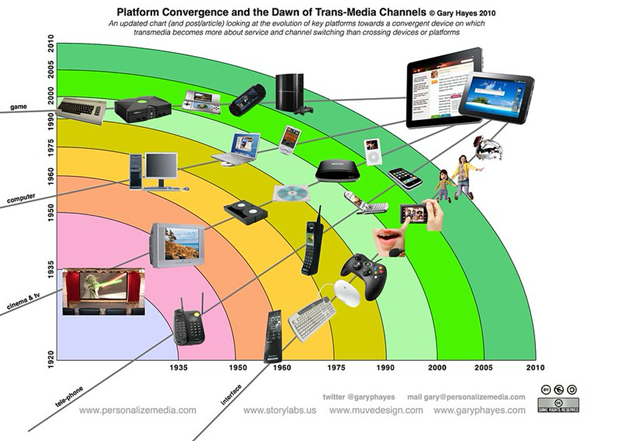
Henry Jenkins (2006) describes this shift as media convergence, a process in which single messages are disseminated across multiple media platforms simultaneously. Unlike traditional media, where content was confined to specific formats (such as television, radio, or print), convergence allows for immediate reshaping and redistribution of messages.
For example, when someone watches their favourite television show, they might immediately discuss it on a forum, chat room, social media platform, or live tweet their reactions. This interaction extends the life of the original content, transforming it into a dynamic, ongoing conversation.
A striking example of this phenomenon is the rapid spread of information about Osama bin Laden’s death. Before any formal announcement, news of his death had already been tweeted, reposted on Facebook, and discussed across digital platforms, reaching audiences faster than traditional media outlets. This demonstrates how convergence has reshaped the way people consume, share, and engage with information in real time.
From Simulacra to Convergence
In a sense, convergence echoes Baudrillard’s (1981/1994) discussion of Simulacra. Jenkins’s convergence goes further, however, and describes how the technologies themselves, including media consumer practices, are being manipulated and re-conceived by both the industry and the consumer.
CC BY-NC-ND 2.0
The convergence of media has transformed audiences from passive consumers into active participants. Users engage with digital content by sharing opinions, remixing corporate media, and creating original material, contributing to an expanding public audience. This shift blurs the line between consumption and production, allowing individuals to play dual roles as both media consumers and creators (Bird, 2011; Sundet & Ytreberg, 2009).
By enabling participatory engagement, convergence challenges corporate media control. Traditionally, media industries dictated the flow of content, but today, audiences shape narratives by resharing, remixing, and responding to mainstream media in real time. As Henry Jenkins (2006) notes, this has led to an increasingly complex relationship between top-down media structures and bottom-up participatory culture (p. 243).
Some digital media users view social media as a revolutionary force, capable of disrupting institutional media control. While modern audiences have unprecedented access to diverse entertainment and news sources, institutional gatekeeping still plays a role in determining what ultimately reaches the public. Despite the illusion of total control, large media corporations continue to mediate content distribution.
Additionally, digital media has altered how audiences interact with cultural products. Consumers now decide when, where, and how they engage with television, film, and online content. This sense of ownership over media products has sparked debates over authorship and intellectual property. For example, fanfiction serves as an alternative or simulacrum (Baudrillard, 1994), allowing fans to infuse their own perspectives into existing narratives. This participatory reworking of media challenges traditional notions of authorship and control, highlighting the evolving relationship between audiences and media industries.
The “End” of Media Canon? Fan Cultures and Textual Poaching
Fan cultures have increasingly blurred the boundaries between corporate media ownership and audience creativity. Through fanfiction, YouTube videos, and fan films, audiences reinterpret, remix, and recreate established media properties to reflect their own values and perspectives. This process, described by Henry Jenkins (1992) and Michel de Certeau (1988) as “textual poaching,” has expanded rapidly due to the accessibility of digital platforms such as YouTube, fanfiction.net, and Archive of Our Own (AO3).
Jenkins traces the origins of contemporary fanfiction to 1930s pulp magazines and fanzines (1992). However, he argues that certain media texts inspire such passionate fan followings that they revive and expand fanfiction communities, as seen in the 1960s Star Trek fandom (Jenkins, 1992). Today, digital media allows fan narratives to spread even more widely, challenging traditional notions of authorship and originality.
While some media industry professionals support these fan efforts, others attempt to regulate them. For example, Lucasfilm hosts an annual Star Wars fan film competition, actively encouraging audience engagement (Philippe, 2011; Tryon, 2012). Additionally, some fanfiction adaptations have achieved mainstream success, such as E. L. James’ Fifty Shades of Grey—originally written as a Twilight fanfiction (Brennan & Large, 2014; Harman & Jones, 2013).
However, despite their popularity, fan-made media face legal and financial limitations. While transformative works are often tolerated within fan communities, profiting from fanfiction or fan films remains controversial and, in many cases, illegal. As fan cultures continue to reshape media narratives, the debate over intellectual property, artistic ownership, and audience participation remains an evolving conversation in digital culture.
This t-shirt represents fan re-creation of a re-created media narrative.
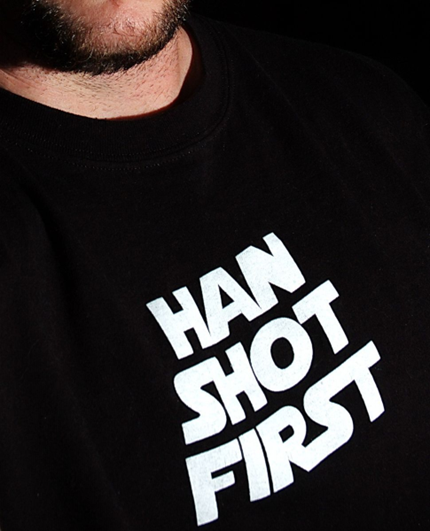
If George Lucas created Star Wars, can his interpretation of its story ever be considered “wrong”? If Lucas openly supports fan films—even those that critique his work—does that suggest he encourages debate about his own creation? This raises important questions about who ultimately controls a cultural narrative: is it the original creator or the fans who engage with and reinterpret the story? For example, the longstanding controversy over whether Han Solo shot first in A New Hope illustrates how audience perception can clash with creator intent.
Consider the reboots of Star Wars and Star Trek by J. J. Abrams. Aren’t these also a form of fanfiction? The legitimacy of fanfiction, fan films, and other transformative media remains debated, particularly due to issues of copyright, ownership, and originality. However, when Disney rejected George Lucas’s ideas for the recent Star Wars films in favour of J. J. Abrams’ fan-informed approach (Owen, 2015), it suggested a shift in how fan engagement is valued. If a filmmaker like Abrams—who began as a fan—can shape an official franchise, does that mean fanfiction has been legitimized as an artistic form?
This trend extends beyond Star Wars. Many franchises, including Doctor Who, Star Trek, Sherlock Holmes, and multiple superhero properties, have undergone numerous reboots and reinterpretations. These reimaginings blur the lines between traditional “canon” and audience-driven influence. Has the entertainment industry moved away from strict adherence to original texts, instead embracing fandom as a prerequisite for franchise leadership (Monagle, 2015)?
Intertextuality and Fluid Ownership in the Digital Age
The digital era complicates traditional notions of ownership and authorship. Because social media spaces are virtual and the rules surrounding intellectual property, content use, and production are often fluid, interpretations of who controls media products constantly evolve. Additionally, digital media thrives on intertextuality—the practice of referencing and reshaping existing media—resulting in an almost hyperactive form of pastiche (Annesley, 2013; Stein & Busse, 2009). Media artifacts are no longer confined to a single platform; instead, they frequently evolve from one medium to another, influencing and being influenced by other texts.
This convergence of media makes it difficult to determine where corporate control ends and fan ownership begins. For many consumers, remixing, resharing, or reinterpreting popular culture is a form of homage to the original work. Others see unauthorized sharing of media as an act of resistance against corporate control and financial exploitation within the culture industry. Still others use fan-made content to critique and “correct” perceived flaws in corporate media.
Ironically, George Lucas—one of the strongest supporters of fan engagement with his creations—has also become a central figure in tensions between corporate media and disappointed fans. As franchises grow increasingly reliant on audience participation, reinterpretation, and digital adaptation, the question remains: who really owns a story once it becomes part of popular culture?
Lost in Translation? The Role of Localization in Convergent Media
Convergent media are not confined to a single geographic region. Producers of mass media design their products to cross cultural boundaries, often tailoring them to appeal to multiple audiences in various nations. To maximize reach, they employ retail and marketing strategies that allow their media products to resonate with diverse consumer groups (De Mooij & Hofstede, 2002; Jenkins, 2004). In some cases, a single cultural product may exist in multiple versions—both official and unofficial—each adapted to meet the expectations of different audiences.
Consider Superman: over the years, the character has appeared in comic books, animated series, live-action films, video games, and graphic novels, each iteration reflecting shifts in audience reception, regional preferences, and cultural adaptation. This phenomenon demonstrates how media franchises are continually reinterpreted and reshaped, leading to variations in storytelling, character design, and audience engagement across different contexts.
Case Study: Sailor Moon and the Impact of Media Translation
The globalization of media franchises raises important questions about translation, adaptation, and cultural canonicity. A compelling example is the international multimedia success of Sailor Moon. Originally a Japanese manga series by Takeuchi Naoko, Sailor Moon became a cultural phenomenon in Japan throughout the 1990s, expanding into a broad franchise that included anime adaptations, films, merchandise, and spin-off stories.
Interestingly, the anime adaptation was produced concurrently with the manga, meaning the two versions often diverged in plot, character arcs, and thematic elements. This parallel development of anime and manga is commonplace in Japanese media production, allowing for greater narrative flexibility (Leong, 2010; Newsom, 2004; Newsom & Inuzuka, 2005).
When Sailor Moon was introduced to North American audiences in 1995, it underwent significant modifications. The original Toei Animation series was acquired by DIC Entertainment, which implemented several alterations to make the series more accessible to English-speaking viewers (Cubbison, 2005; Leong, 2010; Newsom, 2004; Newsom & Inuzuka, 2005). These changes ranged from altering character names and editing dialogue to modifying scenes that were considered culturally unfamiliar or controversial for Western audiences.
Leong (2010) explains, “The English dubs of Sailor Moon incorporated familiar domesticating strategies to minimize the foreignness of the original Japanese version” (p. 164).
These alterations reflect a broader practice known as localization, where media products are not only translated linguistically but adapted culturally to align with the values, humour, and expectations of a new audience.
Types of Translation in Media Adaptation
The process of adapting Sailor Moon involved multiple layers of translation:
- From Manga to Anime:
- The transition from a serialized manga to an animated television series introduced narrative differences, as episodes were produced before the manga’s storyline was fully completed.
- From Japanese to English Subtitles:
- A literal translation of the Japanese dialogue into English subtitles provided one version of the series, allowing audiences to experience it with minimal cultural interference.
- From Japanese to DIC English Dub (Localization):
- The DIC dub was not just a translation—it was a cultural adaptation. Scenes were edited, dialogue was altered, and certain themes were censored or modified to suit North American broadcast standards.
These different layers of translation illustrate how media is reshaped and recontextualized as it moves across cultural and linguistic boundaries. While localization ensures accessibility, it also raises questions about authenticity and fidelity to the original work.
For Sailor Moon fans, these differences became a point of debate: Should the DIC version be considered “canon” in the same way as the original Japanese series? Or did the alterations disrupt the creator’s vision? These questions remain central to discussions of global media adaptation, cultural translation, and audience reception in the digital age.
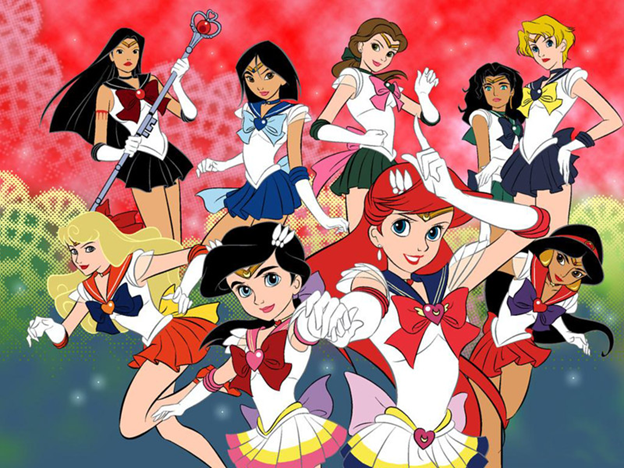
While localization has long shaped the reception of Japanese manga and anime products, Sailor Moon presents an especially complex case due to the sheer number of “official” or “canon” versions that have emerged over time. The numerous adaptations—ranging from manga, anime, live-action series, musicals, and reboots—create interpretive challenges for global audiences.
During the late 1990s and early 2000s, Sailor Moon was reimagined through live stage musicals and a live-action television series, both of which expanded on and altered the original storyline (Leong, 2010; Newsom & Inuzuka, 2005). Each of these adaptations introduced significant variations in characterization, plot development, and narrative structure, further complicating the concept of a definitive version of the story.
Sailor Moon Crystal: A Return to Manga Canon?
In 2015, Toei Animation launched a reboot of the anime titled Sailor Moon Crystal, which was marketed as a more faithful adaptation of the original manga canon. However, despite its closer adherence to Takeuchi Naoko’s original storyline, the reboot also incorporated themes associated with fan interpretations. One of the most notable changes was the survival of the male villains until the end of the first story arc—a departure from their earlier fates in both the manga and the original 1990s anime.
In addition to this reboot, a new official English dub of the original anime was released for North American audiences, removing the censorship and translation irregularities present in the DIC-produced 1995 version. This re-dubbing project aimed to provide a more accurate representation of the original Japanese series, addressing longstanding complaints about previous translation inconsistencies.
Fan-Subbed and Fan-Dubbed Versions: A Fandom-Driven Canon
Before the availability of official, uncensored versions, many North American fans relied on fan-created translations. These included:
- Fansubs: Versions of the anime with fan-generated subtitles.
- Fandubs: Versions of the anime with fan-made voiceovers.
These fan translations spanned not only the anime series but also the films, live-action musicals, and television adaptations. This phenomenon is not unique to Sailor Moon; fan translations have been part of anime and manga culture since the 1980s (Nord & Khoshsaligheh, 2015; O’Hagan, 2009).
Fan translations have sparked academic debates regarding their legitimacy, labour ethics, and copyright implications. Some scholars argue that unpaid, non-expert translations raise concerns about accuracy and intellectual property rights (Cronin, 2012; Hatcher, 2005). However, others emphasize that fan translators play a crucial role in expanding access to media across national and linguistic barriers:
“Both fanned translation and amateur translation share the same idea of unpaid translations by non-experts…[but] fans have played a crucial role in exchanging economic and cultural assets among nations throughout history” (Nord & Khoshsaligheh, 2015, p. 2).
What Is the “Real” Canon?
Even within the officially recognized adaptations, Sailor Moon exhibits major differences in tone, content, and narrative structure depending on the version:
- The original manga by Takeuchi Naoko
- The 1990s anime series (which significantly diverged from the manga)
- The DIC North American dub (which altered character names, relationships, and storylines)
- The Sailor Moon Crystal reboot, designed to align more closely with the manga
- The live-action television series, which introduced new character arcs and relationships
- The theatrical musicals, which added unique interpretations of the story
- The new English dub, which restored elements lost in the 1990s localization process
Given these inconsistencies, fans often debate: Which version is the “true” Sailor Moon canon?
The existence of multiple, conflicting versions has resulted in the blurring of lines between:
- Manga canon
- Anime canon
- DIC North American dub canon
- Sailor Moon Crystal canon
- Musicals canon
- Live-action canon
- New dub canon
- Fan-translations and reinterpretations (Fan-Canon or “Fanon”)
As a result, the process of analyzing Sailor Moon fandom becomes an exercise in negotiating the boundaries between official canon and fan-driven interpretations. In an era of remakes, reboots, and adaptations, Sailor Moon serves as an example of how media franchises evolve across cultural, technological, and fan-driven transformations.
Activity 11: Personal Reflection Journal – Reflection Question 5
Please answer the following reflection question in any format you like (such as in writing, a video, note form, or a drawing). Save your reflection responses in one large file so you can refer to them later in the course if needed.
Reflection Question 5
References
Annesley, J. (2013). Being spike Jonze: Intertextuality and convergence in film, music video and advertising. New Cinemas: Journal of Contemporary Film, 11(1), 23–37. https://doi.org/10.1386/ncin.11.1.23_1
Baudrillard, J. (1994). Simulacra and simulation (S. F. Glaser, Trans.). University of Michigan Press. Original work published 1981.
Berman, A. S. (2001, August 20). Lame TV season? Write your own episodes online. USA Today. http://usatoday30.usatoday.com/tech/2001-02-22-net038.htm
Bird, S. E. (2011). Are we all producers now? Convergence and media audience practices. Cultural Studies, 25(4–5), 502–516. https://doi.org/10.1080/09502386.2011.600532
Black, R. W. (2007). Fanfiction writing and the construction of space. e-learning and digital media. E-Learning and Digital Media, 4(4), 384–397. https://doi.org/10.2304/elea.2007.4.4.384
Brennan, J., & Large, D. (2014). ‘Let’s get a bit of context’: Fifty Shades and the phenomenon of ‘pulling to publish’ in Twilight fan fiction. Media International Australia, 152(1), 27–39. https://doi.org/10.1177/1329878X1415200105
Cronin, M. (2012). The translation age: Translation, technology, and the new instrumentalism. In L. Venuti (Ed.), The translation studies reader (pp. 469–482). Routledge.
Cubbison, L. (2005). Anime fans, DVDs, and the authentic text. The Velvet Light Trap, 56(1), 45–57. doi: 10.1353/vlt.2006.0004
de Certeeau, M. (1988). The practice of everyday life. University of California Press.
De Mooij, M., & Hofstede, G. (2002). Convergence and divergence in consumer behavior: implications for international retailing. Journal of Retailing, 78(1), 61–69. https://doi.org/10.1016/S0022-4359(01)00067-7
Harman, S., & Jones, B. (2013). Fifty shades of grey: Snark fandom and the figure of the anti-fan. Sexualities, 16(8), 951–968. https://doi.org/10.1177/1363460713508887
Hatcher, J. S. (2005). Of Otakus and fansubs: A critical look at anime online in light of current issues in copyright law. SCRIPT-ed, 2(4), 514–542.
Jenkins, H. (1992). Textual poachers: Television fans and participatory culture. Routledge
Jenkins, H. (2004). Mapping cultural flows in an age of media convergence. In M. M. Suárez-Orozoco, & D. B. Qin-Hilliard, (Eds.). Globalization: Culture and education in the new millennium (114–140). University of California Press.
Jenkins, H. (2006). Convergence culture: Where old and new media collide. New York University Press.
Leong, J. Y. Y. (2010). Selling the sweatdrop: The translation of ‘Japaneseness’ in manga and anime fan fiction [PhD Thesis]. University of Western Australia. http://research-repository.uwa.edu.au/files/3223537/Leong_Jane_Ying_Yieng_2010.pdf
Monagle, M. (2015, November 10). Welcome to the era of the fanboy filmmaker. Film School Rejects. https://filmschoolrejects.com/welcome-to-the-era-of-the-fanboy-filmmaker-d864ebab3f37/
Newsom, V. A. (2004). Young females as Super Heroes: Superheroines in the animated Sailor Moon. Femspec, 5(2), 57–81.
Newsom, V. and Montenegro, D.A. (n.d.). 8.5: Convergence Media. In Communication Literary: An Introduction to Communication Studies. https://lor.instructure.com/resources/6632a178ac5040948fc971be0511f98c
Newsom, V. A., & Inuzuka, A. (2005). Creation, recreation and re-creating identities: Performance and interculturality in a global context. In L. Lengel (Ed.), Intercultural communication and creative practice (pp. 61–76). Praeger.
Nord, C., & Khoshsaligheh, M. (2015). Socio-cultural and technical issues in non-expert dubbing: A case study. International Journal of Society, Culture & Language, 3(2), 1–16.
O’Hagan, M. (2009). Evolution of user-generated translation: Fansubs, translation hacking and crowdsourcing. The Journal of Internationalization and Localization, 1(1), 94–121. doi:10.1075/jial.1.04hag
Owen, L. (2015, December 16). Is Star Wars: The Force Awakens just fan-fiction on a big budget? Flickering Myth. https://www.flickeringmyth.com/2015/12/is-star-wars-the-force-awakens-just-fan-fiction-on-a-big-budget/
Philippe, A. O. (Writer). (2011). The people vs. George Lucas [Motion Picture]. In A. Higgs, R. Muratore, V. Philippe, & K. D. Roy (Producer). Exhibit A Pictures/Wrekin Hill Entertainment.
Stein, L., & Busse, K. (2009). Limit play: Fan authorship between source text, intertext, and context. Popular Communication, 7(4), 192–207.
Sundet, V. S., & Ytreberg, E. (2009). Working notions of active audiences: Further research on the active participant in convergent media industries. Convergence: The International Journal of Research into New Media Technologies, 15(4), 383–390.
Tryon, C. (2012). Fan films, adaptation, and media literacy. In J. P. Telotte & G. Duchovnay (Eds.), Science fiction film, television, and adaptation: Across the screens (pp. 176–189). Routledge.