Topic 2: Perception Process
This activity contains text from 2.2 Perception Process in Professional Communication in Health Studies by Chute, A., Johnston, S., & Pawliuk, B. (2023). (CC BY-NC-SA 4.0). Minor changes for readability and to add illustrations as cited from other sources.
In this section of Unit 2, you’ll learn about the perception process.As you read through this section, pay particular attention to the three stages of the perception process: attending to, organizing, and interpreting the information that comes in through your five senses. After all, many of our problems — both in our personal lives and on a global scale — occur due to differences in perception (Wertz, 1982). Although perception is primarily a cognitive and psychological process, it is important to understand because how we perceive the people and objects around us affect our communication. We respond differently to an object or person we perceive favourably — something we like — than we do something or someone who we find unfavourable (Wertz, 1982). But how do we filter all of this information that comes in to us, organize it, and figure out what it means?

Activity 3: Reading – Types of Perception
Please read the following text which gives you an overview of the perception process.
This activity contains text from 2.2 Perception Process in Professional Communication in Health Studies by Chute, A., Johnston, S., & Pawliuk, B. (2023). (CC BY-NC-SA 4.0). Minor changes for readability and to add examples.
Perception
It is easier to make a concrete decision when we have all the facts. We have to rely on our perceptions to understand the situation. In this section, you will learn tools to help you understand perceptions and improve your communication skills. As you will see in many of the illustrations on perception, people can see different things. In some pictures, some people might only be able to see one image, but others may see both images, and a small number of people might be able to see something completely different from others.
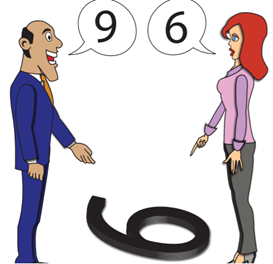
Many famous artists over the years have played with people’s perceptions. The three figures below exemplify three artists’ use of twisted perceptions. Look at the images before you read the descriptions.

Danish psychologist Edgar Rubin created The Rubin Vase. There is what appears to be either a vase (the white part) or two people looking at each other (the black part). This simple image is simultaneously both two images and neither image.
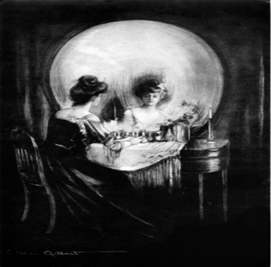
Figure 2.2.3 is Charles Allan Gilbert’s (1892) painting “All is Vanity.” In this painting, you can see a woman sitting and staring at herself in the mirror. At the same time, the image is also a giant skull.
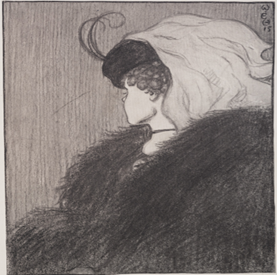
Figure 2.2.4 is William Ely Hill’s (1915) “My Wife and My Mother-in-Law,” which may have been loosely based on an 1888 German postcard. In Hill’s painting, there are two images, one of a young woman and one of an older woman. The painting was initially published in an American humour magazine called Puck. The caption “They are both in this picture — find them” ran alongside it.
These visual images are helpful reminders that we don’t always perceive things the same way that others do, and that there are often multiple ways to view and understand the same events.
In interpersonal communication, you present a side of yourself each time you talk to other people. Sometimes this presentation accurately represents yourself, and other times it may be a false version of yourself. People present themselves in ways that they want others to see them. Some people present themselves positively on social media with beautiful relationships. Then, their followers or fans are shocked to learn that those images are inaccurate representations of one’s life.
Attending
We take in information through all five senses, but our perceptual field (the world around us) includes so many stimuli that our brains cannot process and make sense of it all. So, as information comes in through our senses, various factors influence which stimuli or information continues through the perception process (Fiske & Taylor, 1991).
The first step of the perception process is to select the information you want to pay attention to or focus on, which is called attending. You will pay attention to things based on their look, feel, smell, touch, and taste. At every moment, you are obtaining a large amount of information. So, how do you decide what you want to pay attention to and what you choose to ignore? People will tend to pay attention to things that matter to them. Usually, we pay attention to things that are louder, larger, different, and more complex than we ordinarily view.
When we focus on a particular thing and ignore other elements, we call it selective perception. For instance, if you are looking for a new pair of running shoes, you notice everyone’s running shoes! You’ll notice people wearing Nike, New Balance, Adidas, and Hoka. Once you get your running shoes and don’t think about your purchase as much, you’ll notice athletic shoes and what people are wearing much less often.
People pay attention to certain things more than others for several reasons. We first pay attention to something because it is extreme or intense. In other words, it stands out of the crowd and captures our attention, like a very good-looking person at a party or a big neon sign in a dark, isolated town. We cannot help but notice these things because they are exceptional or extraordinary in some way.
Second, we will pay attention to things that are different or contradictory. Commonly, when people enter an elevator, they face the doors. Imagine if someone entered the elevator and stood staring at you with their back to the elevator doors. You might pay attention to this person more than others because the behaviour is unusual. It is something you do not expect, making it stand out more. On another note, different might also mean something you are not used to or no longer exists for you. For instance, if someone very close to you passes away, you might pay more attention to that person’s loss than anything else. Some people grieve for an extended period because they are so used to having that person around, and things can be different when you do not have them to rely on or ask for input.
Third, we pay attention to something that constantly repeats. Think of a catchy song or a commercial that continually repeats itself. We might be more alert to it because it repeats, compared to something only said once.
The fourth thing that we will pay attention to is based on our motives. One motive might be to get ripped at the gym, and you might pay more attention to exercise advertisements and food selection choices compared to someone who does not have the motive to build their fitness. Our motives influence what we pay attention to and what we ignore.
The fifth thing that influences the selection process is our emotional state. If we are in an angry mood, we might be more attentive to things that make us angrier. If we are in a happy mood, we will be more likely to overlook a lot of negativity because we are already excited. Selecting involves more than just paying attention to specific cues. It also means that you might be missing other things. For instance, people who are in love might pay attention to only the positive aspects of a person they’re in love with and not notice the red flags. The same happens when we end a relationship and are devasted; we might see someone’s negative qualities with greater focus.
We also tend to pay attention to salient information. Salience is the degree to which something attracts our attention in a particular context. The thing attracting our attention can be abstract, like a concept, or concrete, like an object. For example, a bright flashlight shining in your face while camping at night is sure to be salient. You will find salient things that meet your needs or interests, such as if you are a hockey fan, you’ll recognize your favourite players if you are out at a bar, while people who are not interested in hockey won’t even notice them. Expectations also affect what we find salient, such as if you are expecting to enjoy a new experience such as going to an art museum, you’ll notice positive things about the museum such as new exhibits and the nice cafe.
Organizing
Think again about the three images above (Figures 2.2.2 to 2.2.4). What were the first things that you saw when you looked at each picture? Could you see the two different images? Which image was more prominent? When we examine a picture or image, we organize it in our head to make sense of it and define it. This is an example of perceptual organization. After we select the information we are paying attention to, we have to make sense of it in our brains. This stage of the perception process is referred to as organization. We must understand that information can be organized in different ways. After we attend to something, our brains quickly want to make sense of this data. We quickly want to understand the information we are exposed to and organize it in a way that makes sense.
There are four types of schemes that people use to organize perceptions. First, physical constructs classify people (e.g., young/old, tall/short, big/small). Second, role constructs are social positions (e.g., mother, friend, doctor, teacher). Third, interaction constructs are the social behaviours displayed in the interaction (e.g., aggressive, friendly, dismissive, indifferent). Fourth, psychological constructs are the communicators’ dispositions, emotions, and internal states of mind (e.g., depressed, confident, happy, insecure). We often use these schemes to understand and organize our received information. We use these schemes to generalize others and to classify information.
For example, imagine that someone is looking to meet a friend or family member in a crowded place. One thing people often do is wildly wave their arms at people to get their attention. People do this because the behaviour is strange, and it also creates a different visual pattern that people will notice. People notice the unusual behaviour and visual pattern, then they try to organize or make sense of what is happening — they must interpret the behaviour.
Interpreting
Although selecting and organizing incoming stimuli happens quickly and sometimes without conscious thought, interpretation can be a more deliberate and conscious step in perception (Vannuscorps & Caramazza, 2016). Interpretation is the third part of the perception process, in which we assign meaning to our experiences using mental structures known as schema (singular) or schemata (plural). Schemata are like databases of stored, related information that we use to interpret new experiences. We have developed complicated schemata over time because small information units combine to make more complex information. So, you must interpret situations after you select information and organize things in your brain. As discussed in the example above, your friend waves their hands wildly (attending), and you are trying to figure out what they are communicating to you (organizing). You will attach meaning (interpreting). Is your friend calling you to their area, are they signaling that they will come to you, or are they lost and need your help?
We have an overall schema about interpreting experiences with teachers and classmates. Based on what parents, peers, and the media told us about the school, this schema developed before we went to preschool. For example, you learned that certain symbols and objects like an apple, a ruler, a calculator, and a notebook are associated with being a student or teacher. You learned new concepts such as grades and recess and engaged in new practices such as doing homework, studying, and taking tests. You also formed new relationships with teachers, administrators, and classmates. Your schema is adapted to the changing environment as you progress through your education. Whether schema reevaluation and revision is smooth or troubling varies from situation to situation and person to person. For example, when faced with new expectations for behaviour and academic engagement, some students adapt their schema relatively quickly as they move from elementary to high school and on to university or college. Other students adapt slowly, and holding onto their old schema creates problems as they try to interpret new information through old, incompatible schema.
Activity 4: Interactive – Attending, Organizing, and Interpreting Activity
Please complete the following interactive activity then finish the topic reading.
This activity contains text from 2.2 Perception Process in Professional Communication in Health Studies by Chute, A., Johnston, S., & Pawliuk, B. (2023). (CC BY-NC-SA 4.0). Minor changes for readability and to add examples.
It is essential to be aware of schemata because our interpretations affect our behaviour (Rumelhart, 2017). For example, suppose you are doing a group project for class and think a group member is shy based on your schema of how shy people communicate. In that case, you may refrain from giving them presentation responsibilities in your group project because you do not think shy people make good public speakers. Schemata also guide our interactions, providing a script for our behaviours. We know, in general, how to act and communicate in a waiting room, in a classroom, or on a first date. Scholars have identified some factors that influence our interpretations:
Personal Experience
Personal experience impacts our interpretation of events. What prior experiences have you had that affect your perceptions? Maybe you heard from your friends that a particular restaurant was excellent, but when you went there, you had a horrible experience and decided never to return. Even though your friends might try to persuade you to try it again, you might be inclined not to go because your experience with that restaurant was not good.
Involvement
The degree of involvement impacts your interpretation. The more involved or deeper your relationship is with another person, the more likely you will interpret their behaviours differently than someone you do not know well. For instance, imagine that you are a manager, and two of your employees come to work late. One worker is your best friend, and the other is someone who just started, and you do not know them well. You are more likely to interpret your best friend’s behaviour more altruistically than the other worker because you have known your best friend for longer and are more involved with them compared to others.
Expectations
Our expectations can impact our sense of other people’s behaviours. For instance, you might expect this to be true if you overheard some friends talking about a mean professor and how hostile they are in class. Let’s say you meet the professor and attend their class; you might have particular expectations about them based on what you heard. Those expectations might be completely false, yet you might still expect those allegations to be true.
Assumptions
Most people have assumptions about human behaviour. Imagine you are a personal fitness trainer. Do you believe that people like to exercise or need to exercise? Your answer to that question might be based on your assumptions. If you are a person who is inclined to exercise, then you might think that all people like to work out. However, if you do not want to exercise but know that people should be physically fit, you would more likely agree with the statement that people need to exercise. Your assumptions about humans can shape the way that you interpret their behaviour. Another example might be that if you believe that most people would donate to a worthy cause, you might be shocked to learn that not everyone thinks this way.
Relational Satisfaction
Relational satisfaction will cause you to see things differently. Relational satisfaction means how satisfied or happy you are with your current relationship(s). If you are content with someone, you are more likely to view their behaviours as thoughtful and kind. However, if you are unsatisfied with your relationship(s), you are more likely to view someone’s behaviour as distrustful or insincere.
Past Experiences
What has happened to you in the past will no doubt affect how you make sense of information around you. For example, if you have had a good experience with a particular company, organization, or brand, you’re more likely to see everything they do as positive. Perhaps you really like a specific brand of shoes or fashion. You’re likely to look forward to their next releases. However, if you go into the store and the staff are snobby and horrible, you may dislike this brand.
Knowledge of Others
How you interpret a situation is often based on what you know about certain situations (Adler et al., 2013). For instance, if you know that someone close to you has a health problem, it will not be a shock if they need medical attention. However, if you did not know this person was unhealthy, it would be a surprise if they were in the hospital. How much you know about someone or something is certainly an influence on how you make sense of what is going on around you.
Activity 5: Video – Product Expectations
Watch this brief video about descriptions of drinking water. As you watch this video, think about how you may have been influenced by expectations of a particular product or service. If you know that something costs more, are you more likwely to think that it is desirable or of good quality? If someone recommends a product or service to you, are you more likely to perceive it as favourable?
Tap Water Test [duration 1:44]
(jvsd, 2006)
Media Attributions
Chute, A., Johnston, S., & Pawliuk, B. (n.d.). 2.2 Perception process. In Professional communication skills for health studies. MacEwan University. https://openbooks.macewan.ca/professionalcommunication/chapter/2-2-perception-process/
Khoo, M. (2018, January 19). Person holding clear crystal ball [Photograph]. Unsplash. https://unsplash.com/photos/person-holding-clear-crystal-ball-HLA3TAFQuQs
Reference
Adler, R., Rosenfeld, L. B., & Proctor, R. F., II. (2013). Interplay: The process of interpersonal communication. Oxford.
Fiske, S. T., & Taylor, S. E. (1991). Social cognition (2nd ed.). McGraw Hill.
Rumelhart, D. E. (2017). Schemata: The building blocks of cognition. Routledge.
Vannuscorps, G., & Caramazza, A. (2016). Typical action perception without motor simulation. Proceedings of the National Academy of Sciences, 113(1), 86–91. https://doi.org/10.1073/pnas.1516978112
Wertz, F. J. (1982). The findings and value of a descriptive approach to everyday perceptual process. Journal of Phenomenological Psychology, 13(2), 169–195. https://doi.org/10.1163/156916282X00055